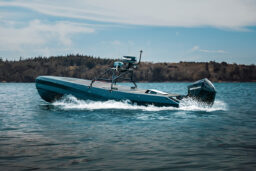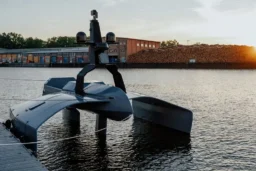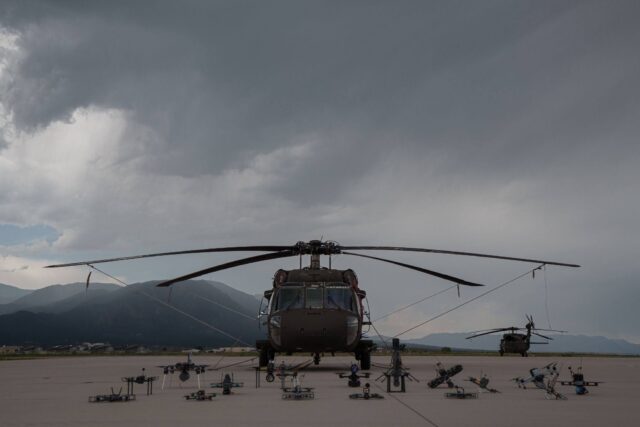
All those shiny fun boats, drones, interceptors, and missiles you guys make are fun and all, but they’re not all that helpful if they don’t have reliable comms to, like, tell them where to go.
Luckily, Sweden-based TERASi is here to help—and they’ve now got a whole new pile of cash to help them do it.
Yesterday, the “unjammable and undetectable communications” startup announced that it’s raised an €11M seed round to scale the deployment of its wireless comms system.
- The round was led by the NATO Innovation Fund and JOIN Capital, with participation from new backers In-Q-Tel and D3.
- Returning investors Navigare Ventures, Almi Invest, Onsight Ventures, Further Than Capital, KTH Ventures also jumped back on the cap table.
TERASi co-founder and CEO James Campion told Tectonic that this money will help to “industrialize” (read: scale production of) their comms system and expand internationally (particularly in the US, Ukraine, and the Nordics).
“Our goal was really to build out a cap table with international presence and with access to key markets,” he said. “The money is for industrializing. We have the first product [and we have to] start ramping volume. [Then we will look at] expanding the product lines. So basically, bigger versions of the same thing, longer ranges, more data.”
“We saw that this team was thinking the long game, and this is exactly what we at the NIF really appreciate,” NIF Partner Sander Verbrugge added to Tectonic. “If they deliver on what they need to do, and we have all confidence they will, they will need more scaling capital very quickly.”
Getting out ahead of the next round. We love to see it.
Come in, come in: Now, comms may not be all “shiny go boom,” but making sure your assets can stay connected when things are super jammy or spoofed is pretty critical to modern conflict. (Just ask the Ukrainians.)
TERASi’s solution to the whole comms-in-a-world-of-EW problem is (put very simply) a super small, high-bandwidth directional radio called RU1—basically wireless fiber for the tactical edge.
- The company’s comms systems function at millimeter-wave (and, eventually, smaller) frequencies, where there is actually a ton of bandwidth available.
- Instead of broadcasting RF broadly (like a typical tactical radio), it sends a very narrow, highly directional beam between two points. That gives you gigabit-class data rates, very low latency, and a signal that’s a whole lot harder to detect, intercept, or jam.
- The radio itself is about the size of a smartphone and, per the company, “can transmit huge volumes of gigabytes, up to 50 times faster than satellites, covering distances over 100 km.”
The company’s secret sauce is called AirCore, a piece of RF architecture inside their radios that takes transmissions and whacks them down into those millimeter-wave frequencies. The whole thing is designed to be, well, small, and—importantly—compatible with COTS (read: cheaper and more available) parts.
“We built the product around existing chipsets from other markets,” Campion said. “We’re using telecom chipsets, automotive chipsets, and then with the AirCore stack, we can essentially add massive performance gains to those [to] deliver a completely new product.”
Hit me up: So, you might still be wondering, well, why do we here in defense tech land care? Well, lucky for you, we had Campion lay out a few key use cases.
“If we start with the simplest possible thing, you can go out and essentially just start replacing Wi-Fi and fiber links,” he said. Anywhere you’re using wifi and fiber to connect two or more things (even, like, just static positions), you can use this instead.
Then, there’s the more tactical side of things.
“One of the things we’re looking at is covert surveillance,” he said. “Imagine you have an airborne platform flying around in an environment where traditionally you’re completely cut off…with this type of capability… you can get all the data out of your sensors in real time, without getting detected.”
“That is huge for operating in, particularly, frontline environments, deep strike, those types of things,” he added.
Build up: Over the next 18 months, Campion said, they will get the comms system “built out, proven, [and] build it more into a complete product suite than a standalone.”
- The money will fund increased production, growing the team, and integrating with more armed forces.
- They’re also working on partnerships—one of their key go-to-market strategies is integrating directly with hardware producers (like the primes).
- And they want to expand way beyond just the radio—they’re looking to expand towards a broader tactical-edge system that combines comms, spatial awareness, EW. Basically, all the stuff you need to stay connected at the edge.
“Connectivity is a decisive capability on the modern battlefield,” Verbrugge said in a statement. “As hybrid warfare puts satellites, fixed infrastructure and GPS under constant threat of jamming and spoofing, Allied nations need networks that can stand up in minutes and stay secure.”