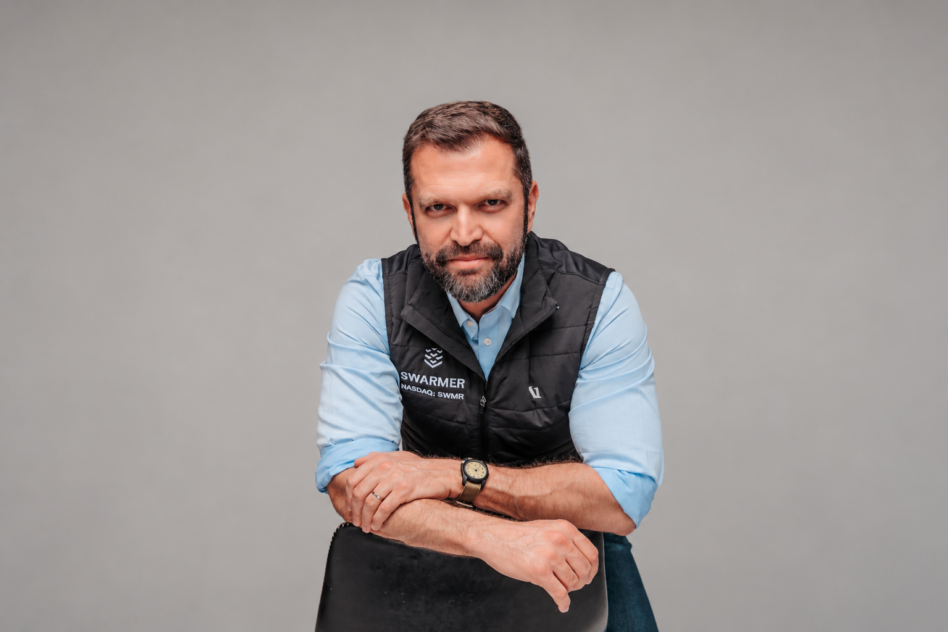
In case you missed it, the infamous Erik Prince and Swarmer’s US CEO Alex Fink are betting on “air defense as a service”—and now they’re putting numbers behind their pitch.
This week—just a month after launch—Vectus Air Defense Systems (not to be confused with Prince’s Vectus Global private military and security company) announced plans to buy at least 40 Swarmer-built air defense systems in the first year of production and 80 in the second.
The system will run about $5M to $6M a pop, and Swarmer plans to manufacture them at a new facility in Poland. Worth noting that Swarmer holds a 20 percent stake in Vectus, and that Prince is non-executive chairman of Swarmer.
Tectonic sat down with Prince—the former Navy SEAL who founded private security company Blackwater—and Fink to chat about the deal, what they’re building with Vectus and Swarmer, and the role of private companies in the future of air defense and cUAS.
Read more below.
Note: This interview has been edited for length and clarity. This is part two of our interview with Fink. For part one with Prince, click here.
Tectonic: Can you discuss the partnership you now have with Erik Prince through Vectus?
Alex Fink: There are two parts to it. The first one is that we are a founding member of Vectus, and we have 20 percent of the founding shares.
The second one is that we are becoming a supplier to Vectus. We announced that today for at least one of the systems. But, obviously, we want to supply as many of the systems as possible.
Vectus will use some things that they make themselves, and some things that they get from elsewhere. But the idea is, we are a product company; Vectus is primarily a service company.
We’ll try to supply as many products as possible—some things that we make ourselves, some things that we license.
Where did the idea for this partnership come from? Why was Swarmer the company Vectus wanted to integrate into its defense and protection system?
Erik Prince has been talking about this for a while, and we always thought it was an amazing idea because it looks like most governments and most companies in the world have no good way to protect their critical infrastructure right now.
None of the things that have been used in the West traditionally are usable now. Warfare has changed a lot, and it’s hard to get technology out of Ukraine because, in Ukraine, that technology is used with a certain infrastructure in place.
If you’re building an interceptor in Ukraine, all you have to do is integrate with Sky Map, and you get your target list. You know where to aim.
In any other country in the world, you don’t have that. You have to bring your own radar and figure out how to integrate with it.
Also, in Ukraine, you have a lot of pilots who can fly an interceptor. No other country has that. Flying an interceptor is really, really hard. It’s like being an FPV pilot, but 10 times faster.
We help Erik solve for that. But ultimately, my point is that Vectus is necessary because no other country or company can solve for these threats by themselves, except for perhaps a few. We wanted to be part of it because we believe Vectus is a great idea.
Since we already have a preexisting relationship with Erik, he knows what we have. He knows our software is good at combining multiple types of hardware into an end-to-end chain, and that we can act as the glue between different types of systems. He knows that we can take a system that works one-to-one and make it work many-to-many.
He basically knew that if he’s going to build end-to-end solutions, it might make sense to use the guys who already make the glue.
That being said, we can sell just the glue, or we can make other things as well. Since we’re already in the design and already have the software that combines these hardware systems, why don’t we also just supply some of the hardware?
That’s where the other technologies you’ve seen come into play. We want to sell more than just Swarmer products, essentially.
You say your software has supported more than 100,000 combat missions in Ukraine. How many of those missions generated revenue for Swarmer?
All of them generated [revenue]. The ones that are in the backlog and are not recognized as revenue yet are missions that haven’t been counted yet.
When you see “missions,” that means that the drone maker has shipped their hardware to the government, and therefore we will recognize the revenue from that drone.
What’s the largest swarm you’ve ever sent up?
We can support up to 690.
The largest that we’ve simulated is probably a couple hundred. The largest that we saw somebody actually put in the field at the same time is about 25.
This is, by the way, one of the reasons why we really wanted to acquire a ground-vehicle company. Ground vehicles solve part of the limitation that makes for this difference, which is that it takes a long time to set up these drones in the field.
By the time you’re on drone 10 or 15, you’re being targeted by Russians.
What a ground vehicle allows us to do—or allows the people on the front line to do—is set up everything on ground vehicles, send it out, and now you can launch a larger group.
The real limitation in the field is how long you have to set up. If we solve for that by putting it on an autonomous vehicle and then shipping it to the field, [we can launch larger swarms].
What is the cost of taking down a drone with Swarmer?
It depends on what effector ends up being used.
The effectors we saw earlier [an interceptor], you’re talking about somewhere between $5,000 and $20,000 per kill. But that is the last line of defense. That will be the most expensive one. That’s after all the others failed.
How autonomous is this system?
This system right now acquires the target roughly from the radar, then acquires it much more precisely with an infrared camera. That camera, through the fire-control system, directs the gun.
All the human needs to do is confirm that that is a valid target and not a false alarm.
How long does the human have to confirm? How sure are you that someone is able to identify whether it’s the correct target?
In theory, that depends on how late you detected it. But the radar’s range is up to 30 kilometers, and you end up shooting when it’s less than two. So you have a lot of time to look at that thing before it gets within machine-gun range.
How long is “a lot of time”?
It depends on how fast they are flying.
If it’s a regular Shahed that’s flying at 190 kilometers per hour, that’s roughly 50 meters per second. So, at 30 kilometers, you have a lot of time.
Who is liable if there is a mistake? Is it the country, Vectus, or the person who pressed the button?
I will give you the general answer: Machines are never liable. They are tools. Humans are always responsible for the end result.
They shouldn’t just be in the loop. Humans should be the responsible party.
Now, how the country allocates that responsibility between humans depends on the country.
If that person sitting there is a soldier, probably the country is liable. If that person sitting there works for a private company, I hope that private company has a deal with the country so that they agree that the private company is allowed to shoot things down.
It will vary from country to country, I think.
But in Ukraine, you’re beginning to see private air defense already, where there are some companies that receive licenses from the government to protect a particular site.
Has a Swarmer-enabled drone ever identified a specific target and initiated an attack without a human separately approving that strike?
No.
Everything that we’ve done so far, a human at least approved that target on video. That has happened every single time, both in combat and in testing. There’s not a single example.
Now, we have a type of mission where that’s not necessary, but nobody has flown it in combat before.
What is that mission?
It’s called Killbox.
This is something that you find in NATO doctrine, where the human pre-approves an area and type of target. Anything of that type in that area for a period of time is pre-approved.
For example, if you have a square kilometer where you say, “There should be no vehicles there. I know that no friendly can get in there in the next 15 minutes. I pre-approve any vehicle for the next 15 minutes as a valid target.”
So, that mission exists, but Ukraine has not flown this yet.
Are you confident deploying something like Killbox, even with the risk of targeting mistakes by autonomous systems?
I think so, because the point is we’re still requiring the human to be responsible. We’re just asking them for a larger amount of responsibility.
A human could approve a 5.56-millimeter bullet going one kilometer, or they can approve a drone going 30 kilometers out and blowing up a fairly large area. Or they could approve a one-ton bomb, which could basically take out something like a 300-meter radius.
In this [Killbox] case, they’re approving action in a particular box for a particular amount of time for a particular type of target appearing in it. It’s still a human approving it.
We hope the humans will know that’s a larger amount of responsibility.
By the way, if you launch a Tomahawk missile, that takes 12 minutes to get to the target, and you can’t always call it back. So it’s fairly similar to this idea of a Killbox for the next 15 minutes in this particular area. It’s pretty similar to sending a cruise missile.
Are you worried about these swarms getting hacked? What happens if you have hundreds of drones in the air and somebody gets into the system?
We’re obviously worried, and we’re protecting against it. It hasn’t happened yet.
What are you doing to protect against it?
Really good cybersecurity. Everything is zero-trust encryption.
We developed everything ourselves.
We came into this thinking, “We’ll just focus on autonomy. We’ll build great AI.” And the first thing that we understood was, no, first we need a base operating system with good encryption. Because if we don’t have that, then our AI is running on top of a system we cannot trust.
We actually started from that—from the encryption, from secure firmware updates, from proper video streaming, from proper secure messaging between the systems—and then we started building the AI.
You told me earlier about hacking attempts against Swarmer. What happened?
We’ve had several hacking attempts by Russians that failed.
The only times in which we saw that coordinates of where the drones launch from had leaked to the Russians, counterintelligence from Ukraine came to us and basically said, “We’re seeing the coordinates in Russian communications. Investigate.”
We investigated, and we found that basically workers in the factory of one of the manufacturers sold their passwords to Russians. That’s how the Russians got the coordinates.
That is generally a softer vector than hacking the software. The software is pretty secure.
Is there something you’re most excited about when it comes to your partnership with Vectus Air Defense?
Yes, and I probably can’t talk about it.