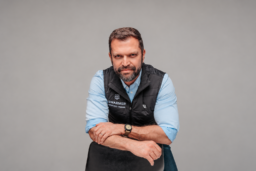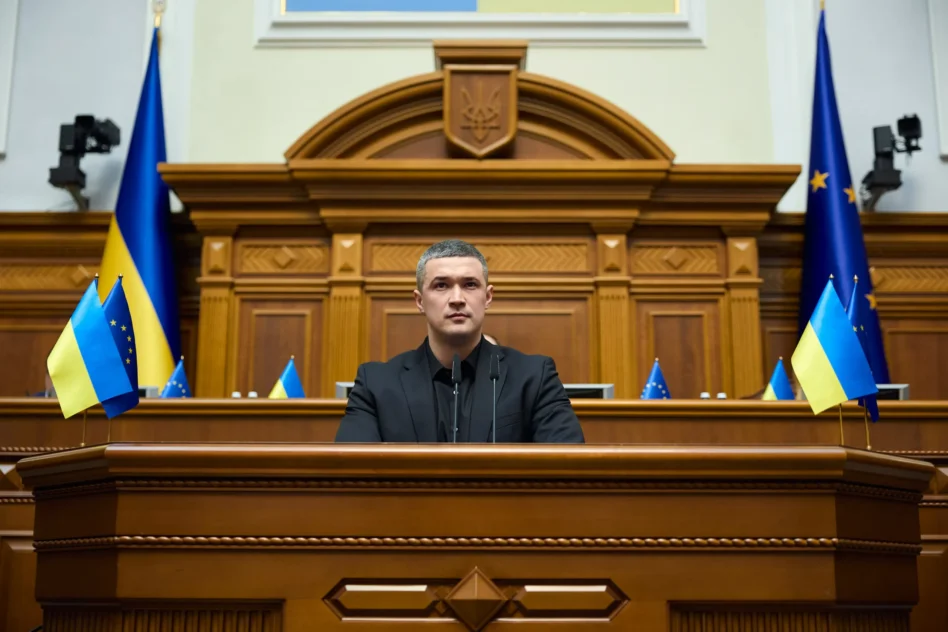
If you’ve spent, like, fifteen seconds here in defense tech land, you probably know who Mykhailo Fedorov is. The 35-year-old served as Ukraine’s Minister of Digital Transformation from 2019 until January of this year, when he took over as Minister of Defense.
During his time in government, he helped spearhead Ukraine’s wartime tech revolution—from launching the Army of Drones initiative to building out the Brave1 defense-tech ecosystem and supporting the development of DELTA (the country’s battlefield situational awareness platform).
But in July, after just six months as defense minister, Fedorov was abruptly ousted by President Volodymyr Zelenskyy amid a bitter dispute with Ukraine’s military leadership. The dismissal sparked widespread protests and calls to reinstate him.
Rather than return to government, however, Fedorov has decided to take his talents to the private sector.
- He’s launching a new defense-tech venture—with Palantir CEO Alex Karp as its first investor—aimed at turning five years of battlefield experience into new technology, from autonomous ground robots to AI-enabled missiles and interceptors, all with the help of Western investment.
- He’s also been on a bit of a world tour, meeting with politicians, investors and defense-tech companies in the US and Europe—and even taking on a new gig as an adviser on defense innovation to Italian Defense Minister Guido Crosetto.
Tectonic sat down with Fedorov earlier this week to talk about what, exactly, he is working on, his time as Minister of Defense, and what he sees for the future of Ukraine—both in terms of the war and the country’s defense tech industry.
Note: This interview has been edited for length and clarity.
Tectonic: Why don’t you tell me what you’re up to?
Mykhailo Fedorov: Right now, I am launching a new defense tech company.
My team and I are trying to transform all of the experience and knowledge that we’ve accumulated over the last five years of modern warfare into a new defense tech company that will ensure the technological advantage of Ukraine over our enemy.
This will help not only Ukraine, but the whole democratic world, protect itself.
Tell me a little bit more about the Army of Robots, and the rest of your work—where are you focused right now, and what do you see as your most important mission?
This new company will, among other things, be investing in other startups. One of those will be the Army of Robots.
The idea is to develop humanoid-like robots to substitute for people where possible. I believe that the warfare of the future is robots fighting other robots. We can see what drones can do, especially swarms of drones—how impossible they make it for human soldiers to stay on the front lines, hide in foxholes. Even logistically, getting into the trenches is very difficult with all the drones above your head, and swarms of drones constantly circling in the sky.
I believe we need to substitute people with autonomy. This is our goal. We are focusing our available resources, engineers, and programmers on gaining this technological advantage because, fundamentally, Russia has more resources than we do.
I announced that we will launch the Army of Robots. We collected 800-plus applications from both companies and individual engineers, designers, and programmers. We already have at least two companies we would like to partner with, and we’ll have our own team of engineers. At first, it will not be humanoid-like robots like Tesla is making—right now, we don’t have access to such technologies.
But on the other hand, we didn’t have access to any drone technologies, and we became the world capital for modern drones. We will also work on UGVs—ground vehicles. We already have capabilities that enable the evacuation of wounded soldiers by robots from the front line. Ukraine is already testing those technologies—the ultimate mission is to have no human soldiers on the front lines.
I know exactly what’s happening at the front lines because I talk to our soldiers. I know that what they need are, for example, sensors to collect as much information about the enemy on the front lines as possible. They also need the ability to process that data and make decisions based on the available information faster and better than the enemy can.
Talk me through the company’s model. How will the combination of investments, partnerships, and your own technological innovation and R&D work?
We are not even announcing the name of this new company yet. For the time being, we are in the preparation stage.
Our lead investor is Palantir, and we have a couple of other large investors—unfortunately, I can’t share their names right now. But our first preparatory financing round will be quite successful.
So far, we’ve conducted 100-plus meetings and calls with various investment funds, technological companies, and beyond. We’re hoping to build a powerful joint venture between international investors and Ukrainian military combat experience. So far, I’ve learned how many Western investors believe in the safe future of Ukraine and thus are ready to join us in this effort. So, it will be a global defense tech company.
One of the areas we’ll focus on will be our own R&D fund, where we will be investing in technologies and products that we believe are of paramount importance to enable our democracy to be able to defend itself.
Also, there are a lot of threats we are dealing with that are not unique to Ukraine. Other global powers are, for example, incapable of intercepting drones in the Middle East. Neither the US nor Ukraine nor Middle Eastern countries can intercept many of these—let alone jet drones and cheap rockets. These are global problems.
Totalitarian regimes, unfortunately, have more people that they can send into the meat grinder on the front lines. Our job is to fight them not with people but with technology, and help the rest of the democratic world follow suit.
Last week, you posted about a jet-powered interceptor that you said had taken down a Geran-5. Could you tell me a little bit more about that, the development process, and kind of where that stands in terms of production?
You’re right. One of our focus areas is on producing cheap interceptors—both cheap drone interceptors and cheap missile interceptors. This is something that we will invest in after we close that first round.
We already have the list of trusted companies and vendors that will be helping us with this. We are also increasing our own team of designers and engineers. Back to your question—we already have an interceptor that can shut down a Geran-5. It’s quite cheap, but we need to scale it up and make it more autonomous.
But that’s just one example, and an example that we can talk about. However, there are other products that we cannot yet disclose—more to come.
I want to zoom out a little bit. The past week has been quite challenging—to say the least—in terms of Starlink and Starshield throttling, as well as a reported halt to intelligence sharing by the US. What are your thoughts on this, and the potentially shifting nature of the US-Ukrainian relationship?
It’s difficult for me to comment on this from the outside. I’m no longer a member of the government, and I no longer have access to some information because I’m no longer privy to the discussions between our office of the president and the White House in the US.
I would say the best way to describe the situation is that it’s very disconcerting. But this is a manufactured crisis that will come to an end, and the US will continue helping Ukraine as it did before—probably even more so. Like the rest of the world, I am very much concerned with what happened in the past week, but I can only hope that it will not affect the situation at the front negatively.
What are you most concerned about in the coming months, especially as winter approaches? What is the top threat you are trying to build for?
For me, the biggest threat is ballistic missiles hitting our energy grid.
I’m also worried about the scaling up of cheap missiles and jet drones by our enemy—we will have to scale up the production of interceptors to shoot down cheap missiles like the Banderol. Russia is pushing to make them cheaper and to increase their production—that’s why they will remain a huge challenge for Ukraine.
In terms of the air domain—Russia is unable to achieve any success on the battlefield. That’s why, instead of fighting our military, they are trying to terrorize our civilians. They want to freeze our cities. Russia wants to create discord within society, stamping on our will to fight—those psychological threats are as dangerous as kinetic threats.
What Ukraine needs are advanced technologies. For instance, the proper warheads to intercept Russia’s missiles. Our own radars monitor their flight. Drones that can navigate autonomously. We need to move to the next technological level.
To date, we have solved every problem that’s cropped up. We didn’t have enough military technology, so we started using drones and quadcopters. We didn’t have a navy, so we came up with naval drone kamikazes that sank Russian ships. But now, that’s all in the past.
Now, we can no longer make do without Western capital and Western investment. New technologies need huge amounts of investment.
My new company will work on ensuring technological advantage for Ukraine. Our solutions will be important not only for protecting the power grid in Ukraine—but they can also help in Berlin or the UAE, which are also under the threat of drones and other aerial threats.
What else?
In addition to air, there are also a lot of land threats. Russia has learned how to deprive us of our ISR drones, for example—they shoot them down. Our enemy is also becoming more efficient against our mid-strike capabilities.
That means we need to use faster drones. We also need access to long-range artillery and deep-strike jet-powered drones that can conduct missions at operational depth, deep inside enemy territory, targeting their drone operators in particular.
These are the problems we’re focused on. But the Russians are also finding ways to present new challenges to us. Our key job right now is to make it impossible for the enemy to gain operational advantage on the ground. We initially deprived them of air superiority, but now—because of jet-powered drones and cheap ballistics—they are prevailing in the air domain.
We need to put a stop to this aerial dominance. As soon as they are no longer dominant in the air, this war will be senseless for Russia. They are not able to break through our fronts, and we are killing 30-35,000 Russian soldiers a month.
We are ready to kill off as many Russians as they mobilize, but first, we need to ensure that Russia doesn’t have aerial superiority.
What are the technologies right now that you think are most needed to achieve that air (and land) superiority for Ukraine?
Anti-ballistics, of course. Cheap missiles and interceptors. Cheap strike capabilities, including mid-strike and deep strike. Humanoid robots, laser weaponry, and jet-powered strike capabilities. All of this, plus our own ballistic missiles.
My company is focused on all of these areas, and on employing the best engineers to build these.
We also need software to ensure autonomous performance of those drones and interceptors—everything is becoming faster and more autonomous. All those sensors, drones, and robots will need to communicate with one another, and autonomy will speed up decision-making.
When I was still the Minister of Defense, I launched the development of a software tool that would allow us to better analyze the battlefield in real time and make more accurate predictions as to where the Russians would be moving their troops. Whichever side is able to use AI to speed up decision-making will definitely gain battlefield advantage.
You mentioned sensing and data analytics earlier. Could you talk us through your thoughts on where Ukrainian capabilities stand in terms of sensing, radars, and situational awareness?
Currently, we have DELTA, which is a Ukrainian-built situational awareness tool. We also have NEON, which is the aerial situational awareness system that allows us to collect a ton of data. But we need our own software that can analyze all of this data and help us with predictions.
We need something like ChatGPT for military purposes, where you can ask the system any question. For example, you can ask, “Why are we struggling in the village of Konstantinovka? Or why, at this stretch of the front line, do we still have risks?” The system will then suggest explanations or courses of action to us.
When I was Minister of Defense, I had the idea of appointing a separate deputy minister of defense focusing exclusively on AI predictions and analytics. We are operating with such a tremendous amount of data from a multitude of sensors. People are not able to process it—only machines can handle this kind of data flow.
Is that part of the partnership with Palantir? That sounds a lot like their area of expertise.
We’ll see. We plan to create our own software. If Palantir helps us with that, fine, more power to them and to us. But for the time being, we are not dependent on any vendor. We have the liberty of creating and inventing whatever we like.
Ideally, of course, whatever solutions we come up with will just help us win this war as quickly as possible.
Let’s move on to your time at the top of Ukraine’s MoD. What do you think was your biggest accomplishment in your tenure as Minister of Defense?
I think my greatest achievement was introducing new procurement approaches. That meant that we started getting higher-quality drones, electronic warfare devices, radars—all sorts of capabilities.
Also, switching off Starlink for Russia. That was a game changer—we started losing less territory and even started making territorial gains. In an era of technological warfare, we left Russians blind and deaf.
Another achievement was making sure Russia’s Shahed drones were no longer a threat to Ukraine. Our air defense systems can easily handle Shaheds now. Unfortunately, not jet-powered drones. I worked a bit with jet-powered drones, but that was in the last stretch of my tenure as minister.
But we did completely neutralize the Shahed problem.
Is there anything you wish you’d been able to do that you weren’t able to? Anything you regret or wish you’d done differently?
I would probably bring more people into the Ministry of Defense from the business community and introduce a new military culture. I mean, we had a great strategy—the Air-Land-Economy strategy.
My team created a new plan for how to win this war, partners got on our side, we delivered, and we started killing more Russians on the front lines. We started intercepting more aerial targets. We started exhausting Russia’s economy—see? Air, land, economy.
I had dozens, and then hundreds, of small projects with dedicated managers. In those six months, we started to prevail. We even started testing our own ballistics quite successfully.
We found out where to procure cheap missiles, and we started buying thousands of them. Anti-ballistic missiles, and PAC-2s and PAC-3s. Strategically speaking, everything was fine and dandy. In six months, we achieved more than ever before—we worked 24/7 to make it happen. That’s why we’re successful.
How has the conflict changed in the three months since you left your post as Minister?
In the past three months, Russia started hitting our economy very hard. They’ve started destroying our logistics, our warehouses. They’ve started hitting us with jet drones.
They’ve also increased the production of drones of all kinds, and we have certain areas on the front lines now where they have more drones than we have. They’re also becoming more efficient with how they handle drones.
All I am thankful for, for the time being, is that Russia is not using artificial intelligence for combat targeting. Often enough, they miss their targets. I am worried about the moment when Russia starts using AI for targeting purposes.
We need to be ready for that. AI is already helping us with targeting, so I know how potent the weapon is.
Things are moving much faster. Modern warfare is all about how fast you can scale up. If any piece of technology works, you need to scale it up fast because the window of opportunity closes very quickly.
Mid-range strikes and long-range strikes, for example, are no longer as efficient as they used to be. We need to change the engines and scale up fast, and predict how the war will change. Predict what new technology will come into play.
How do you prepare for that, especially in terms of artificial intelligence and potential AI targeting?
We are still ahead of our enemy in terms of AI. DELTA, NEON, and Palantir products all use it, but it’s not enough to have software.
You need to have a clear strategy and a clear mission for why you are using this technology. There are a ton of sensors that collect information from drones and from land robots, but you need to learn how to orchestrate all this data—and do it faster than your enemy.
The timeline from detection to decision-making needs to be very fast. Whatever side can launch the fastest decision-making platform will likely gain an advantage on the battlefield.
What do you think is the single capability—or choice, or development—that Ukraine has made that has made the biggest difference on the battlefield?
Drones, of course. Nobody in the world has better drones than us.
We launched the Army of Drones from scratch in 2022. At that time, nobody believed in drones. But we wrote new rules of engagement. We found the resources to launch drone production.
Ground robots, as well. They can save lives. And naval kamikaze drones, because that changed the naval domain. Also, aerial interceptors. Hopefully, we will soon have cheap missiles with AI navigation, but as of now we don’t.
Oh, and smart ammunition. We learned how to produce ammunition for drones that’s light, but quite powerful, and that can destroy Russia’s cannons and artillery. In a single day, we can destroy hundreds of pieces of Russian artillery. Our modern ammunition is a game changer.
Finally, communications. We introduced a new, modern, secure system of communication that was a breakthrough. This is now a completely new kind of warfare, thanks to these new technologies and, more importantly, the courage of our soldiers.
What about deep strike and long-range strike into Russia?
I think the future is cheap missiles that can fly 1,000 kilometers an hour, or at least 800 kilometers an hour—very fast. Missiles that can communicate with one another and hit the targets together. We need these fast.
But there will also be some new weapons that will hit Russians deep in their territory. But for now, it’s too early to talk about them. They will be a true game changer, not only for this war but all the potential military conflicts in the world.
I’m getting ahead of myself here. But I hope that, thanks to these new technologies, we will hit Russia so hard that they will not be able to return to their senses.
Can you tell me anything more about the technologies? Is this tech similar to what Fire Point and other giants are developing now?
No, these technologies are being developed by other companies, not Fire Point. But this tech is already in active testing.
What I’ll say is it will be a new tool that will allow us to challenge our enemy in the aerial domain. I hope it will roll out in two—maximum three—months’ time. Then I can tell you more.
Let’s pivot to the Ukrainian defense industry. To start off, what are you able to do as a private citizen that you were not able to do as a minister?
Well, first of all, I definitely have more free time on my hands now. I can spend more time forecasting, conducting meetings with engineers and developers, and dedicating more time to analyzing what other technological giants worldwide are developing.
I can also headhunt for the best engineers, developers, and programmers. By way of example, the Army of Drones was a 24/7 job for me and my team. I hardly slept. Now I can dedicate more time to analyzing what my value-add is as a private citizen.
When I was minister, I helped my country build a digital government called Diia—it’s got 24 million users. Also, we launched Diia City, one of the best technological hubs in Europe. Then we launched the Army of Drones. We started the unmanned aerial vehicle forces. We learned how to overcome our enemy with technology.
These are the skills, knowledge, experience, and ideas that I have. Even though I am a private citizen now, my goal remains the same: Win this war and help the rest of the democratic world be prepared for any security challenges going forward. Our goal right now is to take the unique experience that Ukraine, unfortunately, has earned with human lives and help other democracies of the world defend themselves better.
So, as a private citizen, I am now helping not only Ukraine but other democracies as well. By helping Ukraine defend itself, we can help the world defend against threats coming from China, Iran, North Korea, and Russia.
These countries are building enormous capabilities focused on AI-operated drones, while the democratic West is still wearing kid gloves, as they say. They are overly diplomatic. They ignore the nature of modern warfare, or even of drones.
This is a slippery path where the West—global democracy—can lose. My mission right now is to explain to big tech companies around the world that they need to look towards what the military needs. Those brilliant minds have to save the world first, and then they can make living in that world better.
I’m curious what you think are the biggest obstacles or barriers to the export of Ukrainian expertise and technology.
This is what I am working on right now: How to present Ukrainian technology and expertise to the outside world so that investors will trust us and be ready to invest. Regardless of how many new technologies we offer, investors still consider Ukraine to be a risky investment. Right now, my mission is to prove that that’s not the case.
Ukraine is not just asking for investors—we are ready to share our unique military and battle-tested experience. Frankly, if our partners don’t learn from our experience, they will not be ready for modern warfare.
For example—you can put a tank in a warehouse, keep it there mothballed for dozens of years, and then start using it again, no problem. But today’s drones won’t be operational in a couple of years’ time.
You will have new engines, new radars, new acoustic systems. The drone that is modern today will be outdated by tomorrow. But our partners still don’t understand that. They are still investing hundreds of billions of dollars in old-fashioned armaments and weapons that drones will destroy overnight.
Western partners shouldn’t just start thinking about these things once our war in Ukraine is over. Only by recognizing what is happening now, alongside us, will they be able to invest in the weapons and drones needed. For example, you can build a drone factory, but unless you test those drones in Ukraine, on a real battlefield, they will be outdated soon.
That’s where we bring knowledge and experience. I look at some neoprime companies that have invested a lot, but have failed to produce products that could be battlefield-tested in Ukraine. Without that testing, their products will likely be of no use to anyone.
What is the one lesson you hope people learn from Ukraine, especially right now? And what is the one wrong lesson that people are learning?
That’s a good question. It’s difficult for me to single out just one lesson.
I’d probably say that the biggest lesson is that you need to learn how to win in terms of the innovation cycle. You need to win the war of innovation. You need to plan properly, to invest in production facilities in advance. You need to be able to update and change things fast.
But okay, what is the one lesson people shouldn’t learn? Well, they should learn from all of our mistakes. These mistakes are very painful for Ukraine, but if we win this war, that means we have lots of lessons that others can learn from.
You need to be able to forecast and make decisions faster—that’s basically the biggest lesson for anyone out there. And you need to invest—quickly—in robots and drones. As I said, the war of the future is drones fighting drones. Countries that adhere to this will become more powerful.
If Ukraine had not placed its trust in drones in 2022, there may not have been a Ukraine in 2026. That’s why the whole world needs to start thinking about thinking about drones and robots now.