You know how we keep saying that Valinor has made solving the US military’s least sexy, most overlooked problems their whole thing?
Well, they’re taking that to the next level with their newest product company: A software-defined facility management system called Terra that aims to bring predictive maintenance, smart sensors, and mold detection into the government’s hundreds of thousands of deteriorating buildings.
Hubs and spokes: If you’re thinking, “Hey, isn’t Valinor making containerized field hospitals?” or “isn’t that the drone docking company?” you’d be right, but there’s a method to this madness.
Launched last year, the startup is set up as an “operational holding company” with a central “hub” that provides go-to-market, financing, prototyping infrastructure, and legal help to its “spokes,” the subsidiary companies focused on individual products.
- The subsidiary product companies, in turn, have more autonomy over engineering and product development, letting them focus on building the technology while the hub handles the boring stuff.
- Alongside Terra, Valinor’s product companies include a modular drone-docking and charging station (Dispatch), the field-hospital-in-a-box (Harbor), AI-powered glasses (Reflex), a data-capture-at-the-edge software platform (Streamline), and a mini air-launched UAV (Condor).
Terra talk: All those products are varying levels of out-there, but Terra is “very Valinor-shaped,” the startup’s Chief Growth Officer, Kurt Freshley, told Tectonic. Translation: It ain’t sexy, but it’s solving a real problem that’s getting ignored by the crowd.
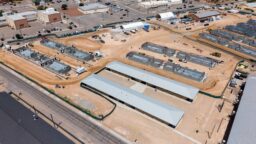
“The Department of War has a $285B deferred maintenance backlog just on their facilities alone, and the US government owns about 700,000 facilities,” Freshley said. “We’re modernizing a lot of things that haven’t been touched by industry for a long time to help take more of a proactive approach to facility maintenance than just being responsive.”
In practice, Valinor’s approach to tackling the very real problem of facility (mis)management centers on a core software platform and hardware.
- TerraOS is a “cloud-based, data-source agnostic facility operations platform” that centralizes building systems, external sensor data, and asset management systems into a single interface, making maintenance predictive and proactive. It’s also purpose-built for government use, meaning it’s fully compliant with all software requirements.
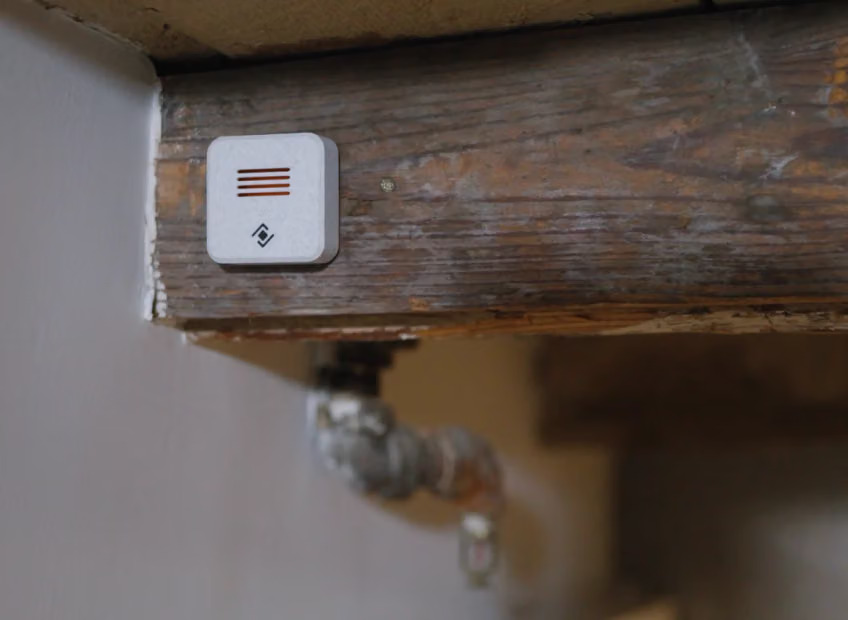
- Terra Smart Sensor is TerraOS’ hardware counterpart—tiny sensors that track and detect changes in indoor environmental quality, like temperature and humidity, and industrial systems health, including water leaks and electrical surges/outages.
- The combined system can alert facility maintenance teams when it detects anything that could cause issues or create conditions for future ones (especially mold) with a handy push notification.
And this isn’t theoretical stuff, according to Valinor. “We’re ready to start deploying sensors before the end of the year, and on track and prepared to scale thousands of these in 2027,” Freshly said. Valinor even has Terra sensors and the software up and running in their office.
Into the future: To address the elephant in the (moldy) room, this is very much not how the US military does facility maintenance management right now. That’s still very much the realm of someone manually checking a room every once in a while.
That antiquated, systemic process is also a reason Valinor’s going after the military customer first. Terra has a ton of potential value in the private sector in industries with sensitive facilities and infrastructure, but, as Freshley put it, “no one’s doing it” for the military.
“It’s easy to go do the commercial side. You don’t have to go through a crazy software accreditation; you don’t have to follow the NDAA for your compute selection or sensor selection,” he said. “These are all things that make it hard to do business with the government, but those are things that Valinor excels at and can offset the cost of with our model.”
- There is also a very clear need for this and a pretty sizeable TAM, given the Pentagon’s $285B deferred maintenance backlog and a whole lot of buildings in desperate need of better upkeep.
It also helps that the military is making facility upgrades a big priority. Last year, Secretary Hegseth announced a Barracks Task Force to develop a “department-wide investment plan for barracks improvements,” citing poor living conditions across facilities and installations.
- “This impacts morale, readiness and our ability to recruit and retain the best warriors,” Hegseth said. “Quality of life for our warriors is a critical component of reviving the warrior ethos and rebuilding our military.”
The first priority for the task force is “leveraging the expertise of private industry to deliver innovative technologies” for maintenance, construction, and renovation, and Freshley said they’ve seen “an overwhelming amount of support and interest from folks helping inform the right piece of this problem set to tackle first.”
As we said, it ain’t sexy, but if no one else is gonna do it, Valinor will.