For an industry that had been all but written off until a few years ago, the nuclear energy startup world is booming.
This morning, LA-based space and defense-focused nuclear startup Antares announced a whopping $470M Series C—including $370M in equity and $100M in debt—to “build reactors” and get them up and running “on military installations by 2028,” CEO Jordan Bramble told Tectonic.
- Longtime backer Caffeinated Capital led the round alongside new investor Paradigm, with Point72 Ventures, Series B lead Shine Capital, Industrious Ventures, and others participating.
- Bramble couldn’t comment on the valuation.
Chain reaction: If you’ve been keeping up with the white-hot nuclear world, this raise shouldn’t come as a huge surprise. Antares has been at the forefront of the Department of Energy’s push to develop and field small modular reactors (SMRs), with the primary goal of feeding the Pentagon’s growing need for a resilient energy supply.
- The DOE’s Reactor Pilot Program, launched last June, set a goal for three of the ten startups in the program to reach criticality—the point at which a nuclear fission chain reaction becomes self-sustaining—by July 4th of this year.
- Four companies met that deadline. Antares crossed the finish line first in June (with a month to spare), with Valar Atomics, Deployable Energy, and Aalo Atomics following in close succession.
- Antares’ Mark-0 test reactor hitting criticality marked “the first time in more than four decades [that] a new privately developed non-light-water reactor has reached criticality in the United States,” Energy Secretary Chris Wright said at the time.
- The startup also did so with the least amount of capital out of the RPP cohort, with roughly just (in very relative terms) $134M raised, including a $96M Series B in December.
Nuketown: Nearly half a billion in fresh cash is both validation of Antares’ performance in the RPP initiative and the key to taking that into the real world with live, energy-producing reactors at a breakneck pace.
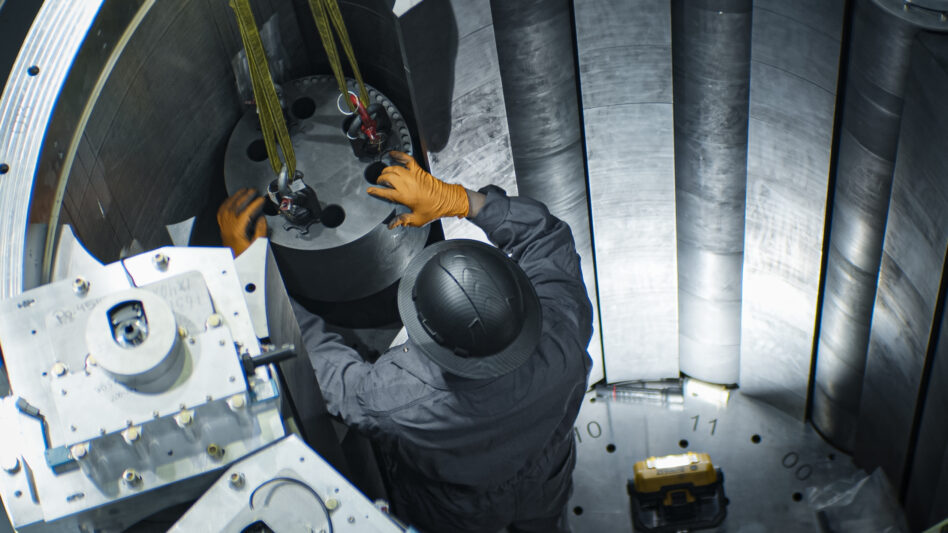
- Antares’ Mark-0 microreactor—housed at the DOE’s Idaho National Laboratory, where it hit criticality—was built to be modular and compact enough to operate off-grid in remote locations, especially military installations.
- The Mark-1, their electricity-producing next iteration, uses the same full-scale core, facility, and fuel as the Mark-0, and is set to come online next year. Antares expects it to produce up to 1 MW of power “reliably and safely for six-plus years without refueling,” according to Bramble.
“Simply put, this capital is going to build reactors, and we’ll have our full commercial product operating and producing electricity at Idaho National Lab next year. For our customers, that means they’ll be receiving systems in 2028 with proven operational heritage,” he said. “We want to be deploying on military bases in 2028, and this is going to allow us to scale production and fund the R&D to make that possible.”
“We’re at a point where every opportunity is in front of us. We have the capital that we need to go execute and get these reactors built, and that’s incredibly inspiring and motivating,” he added. “It’s really up to us, at this point, to get this technology into the field.”
Power up: Antares and their nuclear startup frenemies moving so fast is good news for the Pentagon, which is where that 2028 number comes into play in a few places.
- The Army launched the Janus Program—a next-generation nuclear power program aiming to deliver energy to military installations by September 2028—last October. Bramble couldn’t comment on Antares’ role in that program, but said to keep an eye out for news coming out on that front in the near future.
- The Air Force, meanwhile, is certainly getting in the nuke game with Antares. The service tapped the startup in April to deploy a prototype microreactor at Joint Base San Antonio under the DIU’s Advanced Nuclear Power for Installations (ANPI) initiative by “2028 or earlier.”
- On top of that deployment with the Air Force, Bramble “expects to announce more reactors on military installations in the coming months, and this capital is really going to allow us to do that.”
After that, the startup has its eyes set on “being a resilient energy source for Golden Dome, to power high-powered assets in space, and eventually undersea autonomy,” he added at a White House event celebrating the end of the RPP on Friday.
It’s been a good year for Antares, but given their track record so far and the mountains of cash going into all of that tech (and theirs), we get the sense that they’re just getting started.