There’s no shortage of enemy missiles, drones, and other go-boom tech keeping us up at night, but it’s time for a dose of the super-scary, invisible threats we talk about a lot less.
Luckily, one startup is hard at work building the tech to help us detect them, and it’s catching the attention of the CDC, the Pentagon, and investors alike.
Pilgrim Labs, a California-based startup run by 22-year-old founder and Thiel Fellow Jake Adler, raised $25M in a funding round led by Buckley Ventures to scale production of its biological threat detection system, Argus.
- Anthropic execs Logan Graham and Sholto Douglas also participated in the round, alongside Coinbase co-founder Fred Ehrsam and other tech leaders.
- The round brings Pilgrim’s total funding to roughly $30M.
Going all-in: Every founder talks about pouring their blood, sweat, and tears into their startup, but Adler takes that very literally. Prior to raising $4.3M in a seed round last year, Adler sent a video to investors of himself cutting his leg and sealing the wound with Pilgrim’s first product, a blood-clotting hemostatic dressing called Kingsfoil (yes, another Lord of the Rings reference). It worked.
Pilgrim has since shifted focus to detecting airborne pathogens, but that “we had a joke that, if we couldn’t fundraise, then we would have done a challenge study where [I would] basically individually infect [myself] with a virus to test the system,” Adler told Tectonic, “but fortunately we didn’t have to do that.”
Something in the air: The reason for that shift is simple: The US is dramatically underprepared to detect biological threats at the speed they spread, and current technology is both expensive and outdated.
The US government’s flagship biothreat detection program, BioWatch, was launched by DHS in 2003 and has cost over $1B to date, and even then, it doesn’t detect pathogens quickly or autonomously.
- “Basically, [the BioWatch systems] collect the material every day, and a person has to drive to each system to collect the filter, bring it back to a laboratory, and then deposit it,” Adler said. “And then we’re waiting, 72 hours or upwards of a week before we can even detect a threat.”
- The Army’s own programs are similarly stuck in the past, have run hundreds of millions of dollars, and after decades of R&D, have yet to be widely deployed.
“There is just an inherent, massive, and candidly absurd capability gap in our infrastructure today to actually be able to identify, characterize, and deter biological threats from being able to proliferate across our homeland,” Adler said. “Biological threat monitoring and detection needs to be incredibly prevalent and is frankly a critical necessity for us to have at this point.”
- We don’t need to remind you what the absence of that looks like.
Back to the future: Pilgrim’s take is that the capacity to detect viruses quickly and in the places they’re transmitted is not an impossible task—the foundational tech exists; it just hasn’t been packaged in a deployable and mass-producible system yet.
“The focus of Pilgrim is grounded in the idea of building America’s first biology prime, and really what that means at our core is actually deploying biotechnology more efficiently,” Adler said. “In practice, that’s taking a lot of this really, really critical technology that is languishing, just sitting around in academic papers or in patents, and identifying a way to get it deployed into relevant operational environments.”
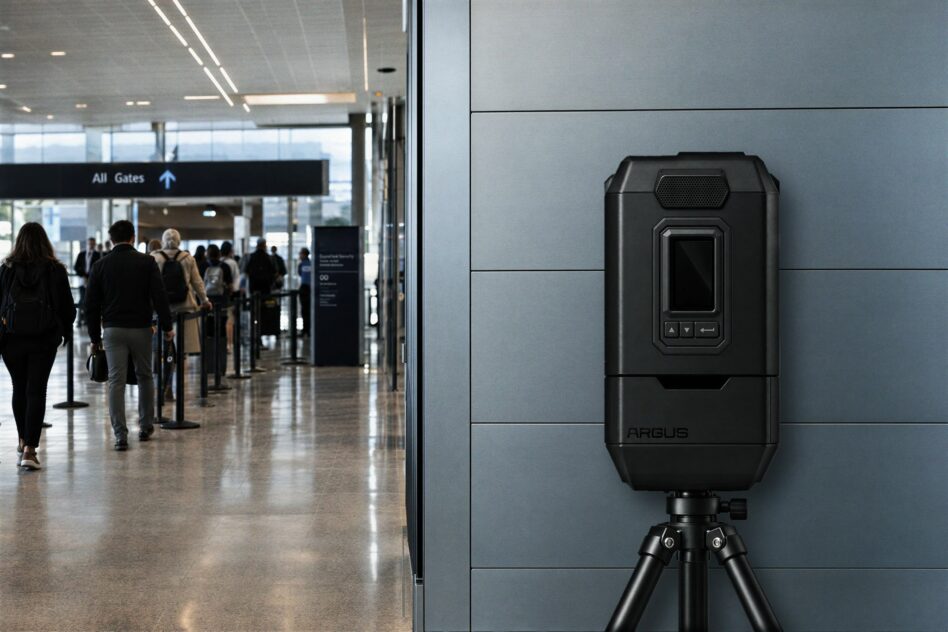
On the spot: The product of that approach is Argus, a 50-pound tripod- or wall-mounted device that, according to Adler, collects 325 liters of air per minute, breaks apart the biological material (like viruses and bacteria), and “isolates the DNA and RNA to run a full [quantitative polymerase chain reaction, or qPCR] sequencing workflow.”
“What that means at a high level is that we can detect anything—it’s completely pathogen-agnostic, and the timeline for that detection, within the entire workflow, is four to five hours,” Adler said. “Technically, we can detect threats in the air in a couple of seconds, so there’s a really unique ability, when you deploy systems like this, to essentially enable localized detection.”
Pilgrim has already deployed Argus in some parts of the country and has inked deals with the CDC for the system, but “there is really an abundance of demand from the defense and national security audience,” he said. “The inherent challenge has actually been our ability to supply units at the scale that they’re looking for, and I think that’s really where a lot of that $25M that we just raised [is going].”
For now, the startup is laser-focused on Argus, but Adler is on a mission to ultimately build the country’s first “bio prime.”
“Bio as a category has been notoriously slow, but it’s also just viewed as pure science,” he said. “I think that there’s this massive backlog of technologies that could be on the battlefield today that just aren’t, and there’s just no good reason why.”
With $25M in fresh funding, growing interest from the CDC, DHS, and defense customers, and a next-level commitment to this mission, Adler thinks Pilgrim is going to be the one to field all of that—and hopefully prevent another pandemic along the way.