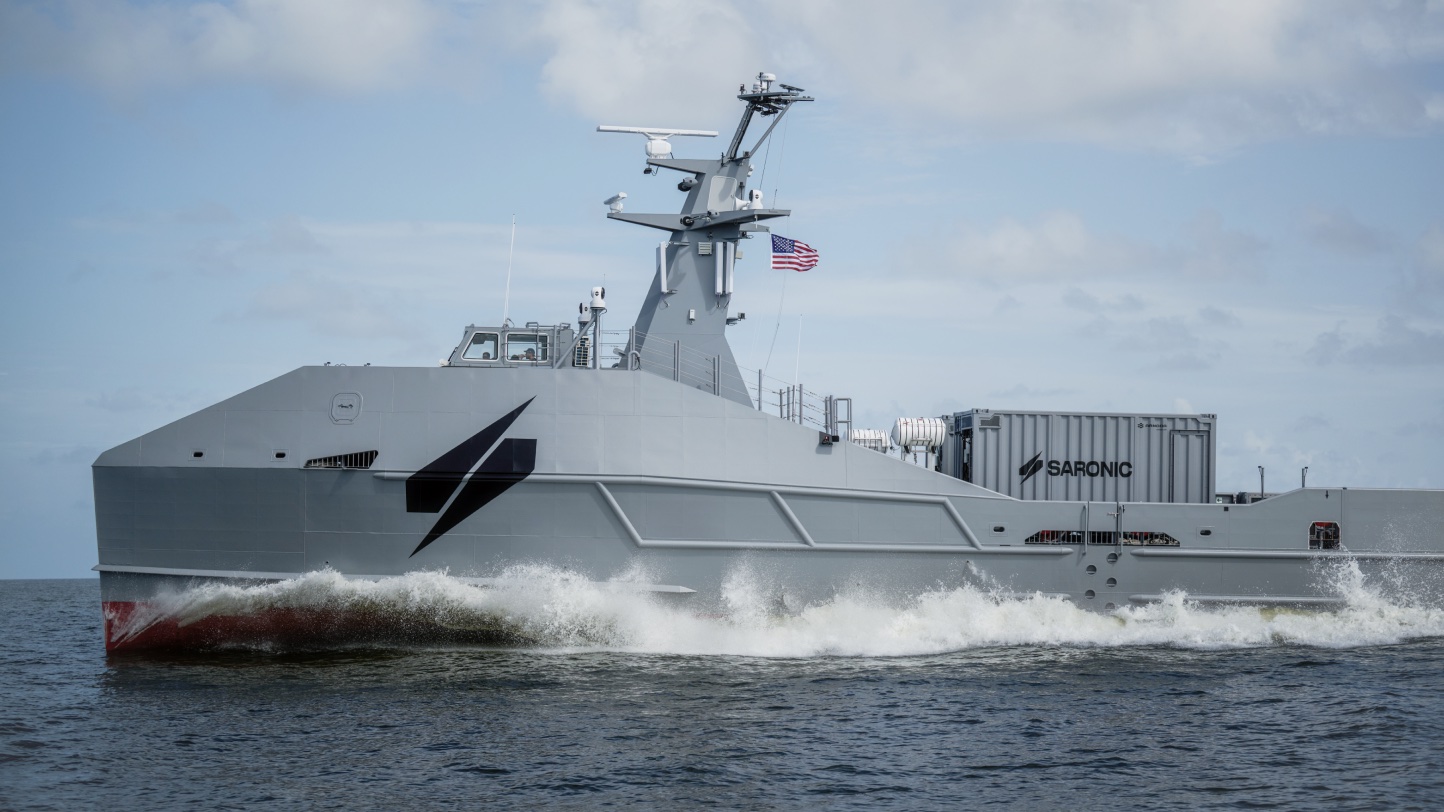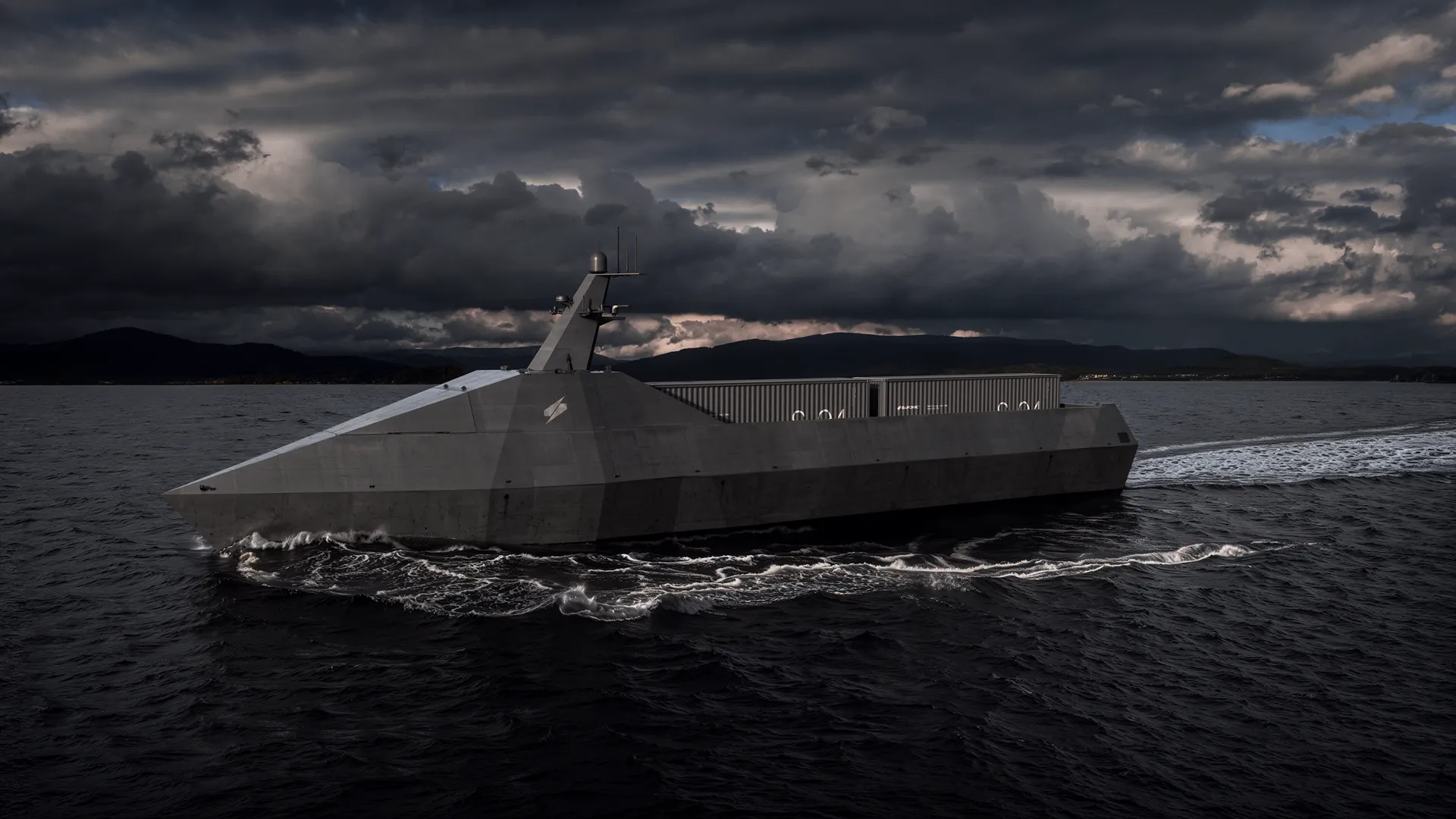
As this week’s buzzworthy drone boat rescue operation showed, Saronic’s autonomous surface vessels (ASVs) have a lot of potential uses. For the company’s biggest and baddest one—the 180-foot Marauder—that includes kitting it out with some serious firepower, courtesy of Castelion.
Yesterday, the two companies announced they’re teaming up to integrate Castelion’s Blackbeard low-cost hypersonic weapon on Saronic’s Marauder—the first such pairing of ASVs with hypersonics, according to the companies—with plans to demo the combo package in an at-sea launch next year.
Making a splash: Now, the Navy has been looking to put hypersonics on ships for a while, but that line of effort falls firmly in the “everything involved is exquisite and expensive” category. The Navy has awarded Lockheed billions (with a B) over the past few years to develop the sea-launched Conventional Prompt Strike hypersonic missile, which is being integrated onto Zumwalt-class guided-missile destroyers.
Castelion and Saronic want to take that idea, shrink it, drone-ify it, and make it a hell of a lot cheaper. The goal is to distribute lower range, cost, and speed hypersonic capabilities across a larger number of vessels to “create more operational flexibility and present adversaries with more launch locations, trajectories, and timing challenges,” the companies said in a statement. “This approach makes hypersonic forces harder to predict, harder to suppress, and easier to scale.”
And both companies are well on their way to validating and deploying their respective platforms.
Boom on a budget: On the Castelion side of the table, the California-based startup is hard at work developing its Blackbeard hypersonic weapon, and raking in some serious cash to do so.
- The Blackbeard—designed as a low-cost (and lower-capability) alternative to Lockheed’s CPS and $ 41M-a-pop Dark Eagle long-range hypersonic weapon—is the company’s flagship product.
- Castelion is developing a ground-launched Blackbeard variant for the Army, meant to be launched from a HIMARS, and an air-launched variant for the Navy. They snagged a $105M contract in April to integrate it onto the F/A-18E/F Super Hornet.
- Low-cost hypersonics (which Castelion is almost cornering the market for) are a huge priority for the Pentagon. On top of being one of the six Critical Technology Areas, the House Appropriations Committee’s FY27 defense spending bill, released Wednesday, calls for $325M for low-cost hypersonic strike systems for the Army and $156M for the Navy.
- The Pentagon also inked a two-year deal with Castelion last month for 500 Blackbeards annually, with the goal of buying 12,000 over five years with multi-year procurement authority after testing wraps up.
Sea legs: Saronic’s Marauder, meanwhile, is already in the water for sea trials after less than a year in development at the company’s Franklin, Louisiana, shipyard.
- It can operate fully autonomously or under remote human supervision and has a top speed of over 25 knots, a range of up to 5,400 nautical miles, a 150-metric-ton payload capacity, and can accommodate up to four 40-foot or eight 20-foot shipping containers.
- Saronic, on top of the Marauder already on the water, has three hulls under construction at its Louisiana shipyard, with plans to increase capacity to produce up to 20 Marauders a year by the end of 2026.
- Saronic’s Marauder was also one of the seven designs that the Navy selected for the Medium Unmanned Surface Vessel marketplace last month.
Combo deal: The Blackbeard variant Castelion is putting on the Marauder, Castelion co-founder and CSO Sean Pitt told Tectonic, is “similar to the ground-launch Blackbeard” the company’s developing for the Army, though it won’t be launched from a HIMARS.
Luckily, this isn’t the company’s first time working together either.
“We actually worked with Saronic on some of our flight tests last year, [partnering] with them to collect downrange telemetry off [Saronic’s] Corsair, so this is a continuation and maturation of that collaboration,” Pitt said.
ASVs are an “obvious use case” for Blackbeard, but Castelion is also looking at putting the system on as many different platforms as possible.
“If a system is capable of accepting a payload in the class of Blackbeard, we want to put it on there,” he said. “If it’s going to support the nation’s ability to prevent future conflicts by showing long-range strike capability on platforms that haven’t existed in the arsenal previously and haven’t been planned for, then that’s a win for the country and something that Castelion will be happy to support.”