Space is no longer a sanctuary.
Case in point, U.S. Space Command’s Space Warfighting Environment 2040 describes a future in which space is more crowded, contested, and central to military operations, with contested space becoming the baseline rather than the exception. The U.S. Space Force’s Future Operating Environment 2040 similarly anticipates continuous competition across cyber, electromagnetic and orbital domains, where adversaries blend electronic attack, space jamming and cyber infiltration.
To prevail in this space warfare environment, the U.S. cannot rely on static defenses or perimeter firewalls. Space and ground systems must be designed to protect boot processes, firmware, configurations, and mission data – even when an adversary gains some level of access. Systems will require deep visibility into their own behavior, from onboard subsystems to ground networks, to distinguish subtle manipulation from normal operations to fight through cyberattacks and continue the mission.
Meeting that standard requires full-spectrum cyber resilience.
Fragility in a Contested Environment
The Space Force’s Dark Horizons scenario depicts U.S. space-enabled “kill webs” that retain substantial capability but become brittle under continuous interference. Spoofing, deceptive signals, and recurring outages erode confidence in target custody and node status. These methods are rarely catastrophic on their own but can lead to hesitation, delay, and declining operational tempo.
A system can be technologically sophisticated yet operationally brittle if every anomaly requires manual investigation, every degraded link creates uncertainty, or every cyber event threatens mission continuity. In a contested environment, small disruptions accumulate and erosion of data integrity and command execution can become extremely detrimental.
The objective should not be to prevent compromise, but to keep systems operable and effective under all conditions.
The Constellation Paradox: Resilience vs. Attack Surface
Proliferated architectures offer an important form of resilience. More spacecraft can provide routing alternatives, redundancy and graceful degradation. USSPACECOM’s 2040 framework explicitly envisions proliferated spacecraft that can absorb and regenerate under attack.
But proliferation creates a paradox.
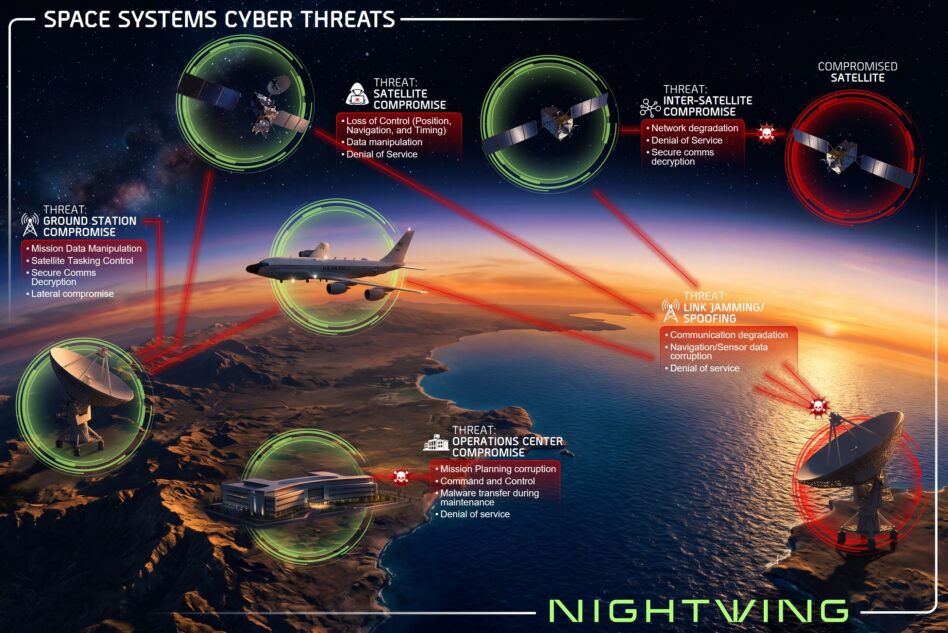
Every additional satellite also means another software stack, identity, configuration, communications interface, vendor relationship, and supply-chain dependency. At constellation scale, quantity can become its own vulnerability. One weak node, misconfiguration, or compromised component can provide an adversary an entry point into a much larger ecosystem.
The lesson isn’t to slow proliferation; it’s to harden it. That starts with an “assume‑breach” mindset, designing constellations to limit damage even if an attacker gets in, and continues with tightly managed configurations and cyber vulnerability assessments [1] scaled to the size and complexity of the constellation.
AI Changes the Tempo
The urgency is increasing because the economics of cyberattacks are changing.
For example, Anthropic’s testing of its Claude Mythos Preview model found capabilities to identify complex vulnerabilities, develop exploits, and chain vulnerabilities into end-to-end attack paths. Anthropic characterized the results as a substantial change in cybersecurity capability.
AI also democratizes access to advanced, highly capable autonomous tools for threat actors, and makes it much easier to execute blistering attacks. Space systems make for a tempting target. AI can examine enormous codebases and configuration sets continuously, while defenders of space infrastructure still have finite time and personnel.
This makes assume-breach architecture and continuous CVA critical.
Cyber Resilience Enables Maneuvers
The emerging emphasis on maneuvers in space makes this even more consequential. USSPACECOM’s 2040 framework identifies in-space servicing and maneuvers as central to a dynamic orbital environment. USSPACECOM and USSF leaders now speak openly about “maneuver warfare” in space with refuellable, repositionable satellites, on-orbit servicing, and the ability to “dogfight in space” through agile, responsive platforms.
But maneuvers depend on trust in commands, navigation data, software, and communications. A satellite that cannot be trusted to execute a maneuver command correctly while under attack quickly becomes a liability. The more dynamic and autonomous the system, the larger the potential consequences if its control software, guidance logic, or data links are manipulated.
Cyber resilience is therefore not an adjunct to maneuver; it is a prerequisite.
Three Imperatives for Leaders
Leaders should demand three capabilities from future space architectures:
- Assumed-breach resilience: Engineer systems to protect critical execution paths, configuration, firmware, and data even after compromise, and incorporate zero-trust principles and resilient cryptography from the outset. Design for graceful degradation so that core mission functions continue under sustained cyber and spectrum attack.
- Offensive-grade CVA: Move beyond periodic penetration testing to continuous adversary emulation across the full mission thread, including AI-enabled attack techniques and supply-chain dependencies.
- Enterprise-scale resilience measurement: Observe how constellations, control segments, and broader kill webs perform under sustained cyber and spectrum contestation. Evaluate how architectures behave when continuously jammed, spoofed, and probed.
The new space environment will not be determined solely by who fields the most satellites or the most exquisite platforms. It will be decided by who can design and build space systems that can keep fighting, deciding, and maneuvering through constant disruption and attack.