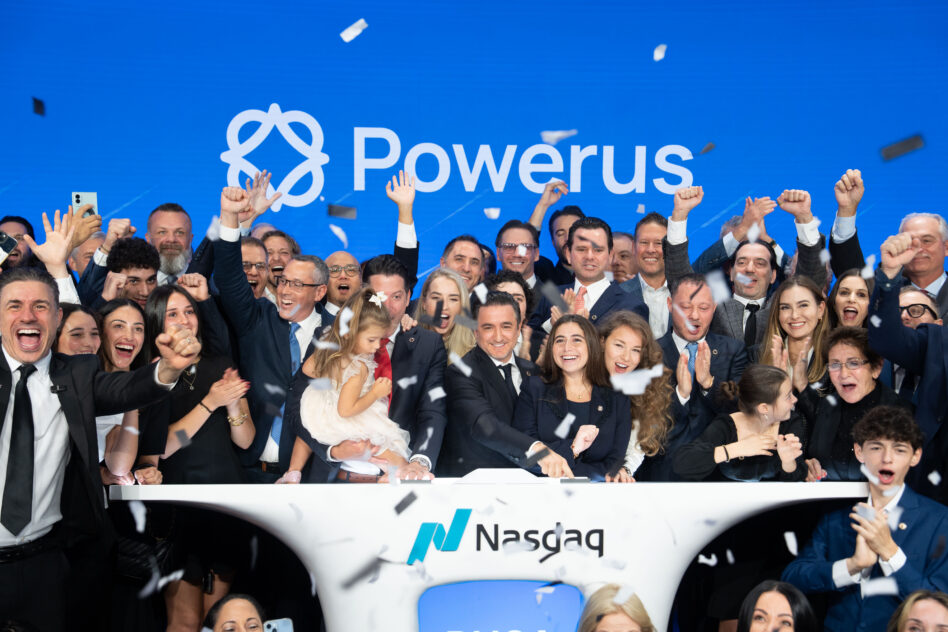
After coming out of pretty much nowhere earlier this year, Powerus has notched headline after headline. But yesterday, the Florida-based drone startup made its biggest power play yet— ringing the bell on the Nasdaq to start trading as a public company.
The company first announced plans to go public back in March via a slightly unconventional merger with Aureus Greenway, a Trump family-backed golf course holding company, after securing investment from the president’s eldest sons, Eric and Don Jr.
- As we said, unconventional, but as Powerus’ advisory board member and former Trump envoy to Ukraine Lt. Gen. Keith Kellogg (ret.) told Reuters, “it never hurts to have their name on something.”
- As for going public with a golf course company, Powerus co-founder and president Brett Velicovich told Tectonic yesterday that “we were looking for a clean mechanism to race to public markets, and that worked for us.”
Power up: Since March, Powerus (now trading under the ticker $PUSA) has inked a string of US military and private-sector contracts for its interceptor, secured $30M in additional funding from drone components manufacturer Unusual Machines, and finalized that merger.
“What we’ve accomplished already in such a short time has just been unprecedented,” Powerus co-founder and president Brett Velicovich told Tectonic yesterday. “In one short year, we turned an idea that was forged in a warzone into a real company, built real capabilities, brought together this incredible team from all walks of life, and today we rang the bell at the Nasdaq.”
Way back: While Powerus publicly emerged in the past year, the company’s story goes back a bit farther. The founders—a crew of ex-military intelligence personnel—met on the ground in Ukraine soon after Russia invaded, where they shuttled “hundreds” of Americans across the border in Sprinter vans commandeered from a tourism company. Movie script stuff.
After seeing how quickly Ukrainian tech was developed and adapted, they decided to take matters into their own hands with Powerus, both by introducing Ukrainian defense tech to the US market and by developing and honing their own tech based on what they saw the Ukrainians doing.
So far, Powerus has a wide range of drone-flavored products on offer, mainly through its subsidiaries. Powerus has three companies under its umbrella so far:
- Kaizen Aerospace, which makes heavy-lift aerial drones with payload capacities ranging from 100 lbs to 1,000 lbs. Velicovich recently told Tectonic that they’re prototyping one with a 2,000 lb capacity.
- Tandem Defense, which makes FPV quadcopters, including one selected for the Drone Dominance Program’s Gauntlet II competition (though it didn’t make the cut afterward).
- Agile Autonomy, which is focused on maritime autonomy and converting pre-existing boats into USVs.
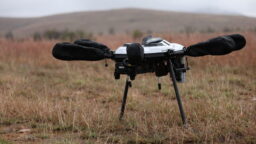
The company has also made a splash with its Guardian interceptor drone. The team inked a $90M IDIQ with the US Air Force for Guardian in August and potentially the first commercial counter-drone deal with an oil and gas company in the Middle East—valued at an initial $22.3M.
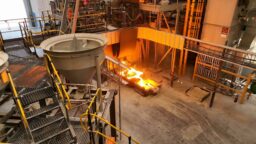
- Velicovich said that the private sector—especially the oil and gas industry—is “an entire area in and of itself that could be potentially a bigger market than traditional defense sales,” adding that Powerus was “one of the first companies that was able to immediately and successfully provide our technology to defend a commercial structure in that particular industry.”
- Powerus has also started manufacturing interceptors with a partner in the Gulf.
Big ups: Going public is all about keeping that momentum rolling.
“Immediate access to capital allows us to build out our manufacturing base, and we’re building out our manufacturing capacity to build drones in rapid quantities at massive scale,” Velicovich said. “That capital [also] allows us money for acquisitions, which allows us to build out our ecosystem, which is paramount to us building an ecosystem where the Defense Department can come to us and see us as sort of a one-stop shop for drone technology.”
The timing—a day after Secretary Hegseth’s State of the Force address—also couldn’t be better, he added.
“We saw the news of the Secretary of Defense announcing the Autonomous Warfare Command that’ll be headed by a four-star general, and that’s a perfect example of exactly why we were built and how drones are just not on the sidelines anymore,” Velicovich said. “They’re front and center, and we’re in such a perfect position to capture that.”