Well, who says an AI-for-defense platform can’t have a major glow-up?
This morning, defense and intelligence AI startup Danti announced in an exclusive release to Tectonic that they’ve launched the new generation of their platform and secured a fresh contract with the US Air Force.
- Danti couldn’t reveal contract value, but said it “focused on leveraging AI to support Intelligence Preparation of the Battlespace (IPB) products for the Department of the Air Force” in a statement.
- The idea is that “Danti’s platform will help commanders fuse large volumes of open-source data to rapidly build situational awareness.”
The revamp comes after Danti was used during US Special Operations Command Europe’s (SOCEUR’s) Trojan Footprint 2026 (TFP26).
“We built this version of Danti sitting next to the operators who use it every day, and they told us the same thing over and over: the model isn’t the capability. What matters is whether the AI works the way a good analyst works,” Danti CEO and Founder Jesse Kallman said in a statement. “Does it know which sources to trust, does it check claims against each other, does it understand what the commander on the other end actually needs? That’s tradecraft, and it’s what we’ve built into Danti’s digital AI analysts.”
Danti, per the company, is now used across SOCOM, the National Geospatial-Intelligence Agency (NGA), the Space Force, the Air Force, and “nearly all combatant commands.”
Rise of the robots: We first told you guys about Danti early last year. Last March, the company announced that its platform (think ChatGPT or Claude, but for high-security environments) would officially be deployed across the US government.
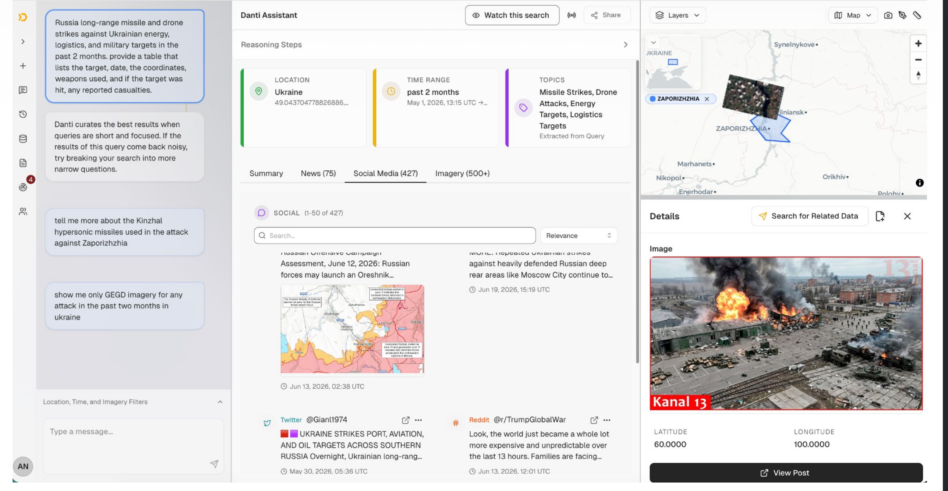
- The platform basically synthesizes all different types of data into one handy-dandy platform—think open-source info, sensor data, tweets, articles, and satellite imagery all mashed together with bespoke government-collected information.
- The idea is that users don’t have to be intel analysts or SIGINT experts—they can simply ask Danti a question, and it can apply all the tradecraft and information it’s got coded in to answer it.
- When we first covered it, the platform functioned pretty much like ChatGPT (like, the chat bit). Users (often frontline operators who needed intel) could ask Danti a question, and it would provide them with a synthesized, neat response based on all those different inputs.
- Even per Kallman’s own admission, back then it was more like super-advanced search—it could give you a whole bunch of collated info on whatever you asked about, like, for example, the location of missile launch sites in North Korea. But it wasn’t really carrying out tasks for you.
Glow-up: That’s where things have changed.
- Now, Danti—like many AI models—has become more agentic. The platform can monitor things for you in the background (like, say, shipping traffic in the Strait of Hormuz), and let you know when something spicy happens.
- It’s also now able to churn out (extremely official-looking) briefs very quickly. That can save operators or intelligence analysts from staying up all night collating and writing up information.
- The new platform also allows you to collaborate with different organizations—and across different languages. Kallman said that during the SOCEUR exercise, Hungarian and Polish special forces were able to collaborate with US users across the platform, despite language and information barriers.
- He also says that the UI has pretty much 100 percent changed, and that “there’s a lot of different AI systems, like the way to intelligently monitor global events and filter information. That’s all completely new.”
“It’s just really powerful and understands a lot more tradecraft and workflows and a lot of different subject matters, so that’s the biggest change in the last year or so,” he added.