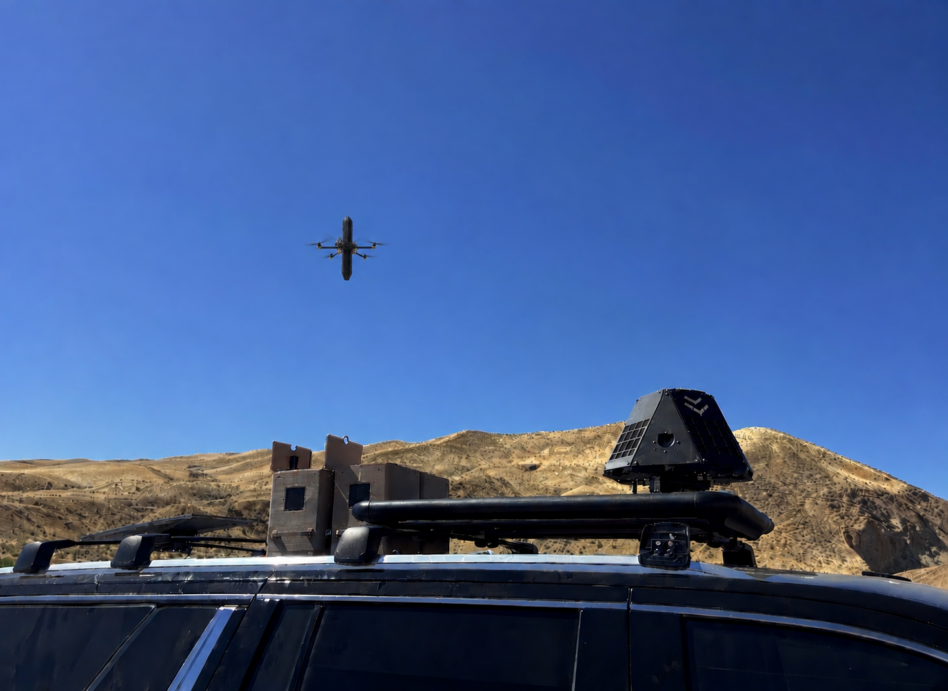
The interceptor space is getting mighty busy these days, but a San Francisco-based startup is betting it’ll be able to stand out from the crowd by making them teeny tiny, mass-deployable, and purpose-built to counter FPV swarm attacks. Some of the biggest names in the VC world agree.
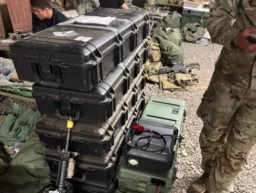
This morning, Mara announced a $7M pre-seed round led by Khosla Ventures to fund the development of Spike, its two-part counter-drone system: a small, man-portable container carrying dozens of super tiny, super speedy interceptors, plus the detection and targeting system that cues and deploys them.
- a16z’s Speedrun accelerator, Night Capital, Palmdrive, Protagonist, Freedom Fund, Indicator Fund, and a handful of angel investors participated in the round.
Small and speedy: Mara, founded by high school friends Daniel Kofman and Sriram Raghu in October 2024, is built around the bet that small swarms of FPV quadcopters, rather than the larger Shahed-type drones, pose a threat to frontline forces that other counter-drone systems aren’t designed for. A lot of that is rooted in Kofman’s experience in Ukraine, where his parents are from and where he’s spent considerable time developing Spike over the past few years.
“What I was seeing from the front line in Ukraine is FPV drones causing the majority of casualties, and they attack in really huge quantity,” he told Tectonic. “They launch from anywhere at anything, and they never attack one at a time. They always attack four to six at a time in waves, doing pincer strikes in rapid succession or simultaneously.”
That specific threat guided the design of Spike, Mara’s full-package counter-FPV platform that comes in two parts:
- Seeker, a tiny, 300-gram tube-launched autonomous interceptor capable of flying 125mph and neutralizing drones at a roughly one-mile range. It uses onboard thermal targeting “with AI target recognition and tracking,” Kofman said. Spike units can pack in up to 48 Seeker interceptors each, deploying as many of them as needed to counter an equal number of incoming FPVs.
- Spotter, the detection system that features visual, acoustic, and other optional radar sensors and in-house AI for “day, night and all-weather detection,” according to the company.
Strength in numbers: By going small, Mara’s looking to give dismounted operators a hard-kill counter-drone system that can be deployed in numbers while staying light enough to carry in the field.
“The interceptor is meant to maximize your magazine capacity, whether the system is mounted on a truck, at a command post set up out of a backpack, or as standalone interceptors on someone’s vest,” Kofman said. “In our view, the constraints are very much the same across those applications—you have to make it small enough to carry a lot of them, because there’s a lot of drones flying at you.”
- The interceptors themselves are fully autonomous, since “an operator just doesn’t get enough time to react or aim in most FPV attacks,” he said, but it’s designed to keep the human in the loop by offering “the ability to abort launches or turn the system to standby mode.”
- Pricing for the full solution can range from $30,000 to around $100,000, depending on the number of Seekers included, and “the interceptors themselves are generally going to be at a one-to-one— worst case, two-to-one ratio against what they’re intercepting,” he added.
Gaining ground: It may be early days, but Mara’s already starting to get traction with Spike.
The startup was selected for NATO’s DIANA accelerator, through which it’s “working with the Czech Republic, the UK, and Poland as our early partnerships in development in NATO,” Kofman said. They’re also working with three unnamed “US military organizations” under CRADA R&D contracts and are “now building for our first paid order from a [European] NATO partner to support an exercise they’re doing.”
“We’re under contract for a man-portable, hand-launched system,” he added. “We’re also under contract for a civilian defense use case”—a pilot program at a South Korean port—a ground-mounted system, and a “combined point-defense system” of networked Spikes.
Those early wins caught the eye of some of the biggest names in the defense VC world.
“Mara has moved rapidly from proof-of-concept to user testing for an autonomous system,” Nicole Fraenkel, a partner at Khosla Ventures, said. “What caught my eye is that they’re building counter-drone autonomy with a system cost that’s orders of magnitude lower than anything else we’ve seen.”