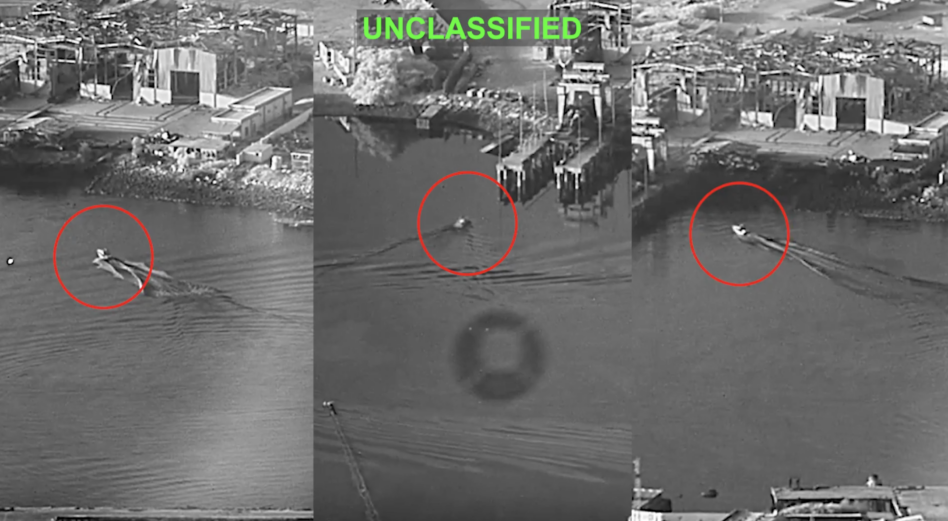
Sounds like someone is learning some lessons in the Strait of Hormuz.
In case you missed it, on Wednesday DIU (which, apparently, has been renamed the War Department Innovation Unit) released a solicitation looking for USVs “fully integrated with two or more mature, market-ready aerial drones to detect, identify, track, and defeat hostile threats.”
The idea is to “fill a critical gap in low-cost sensing and defeat within the maritime environment.” Basically, they want drone boats that can go fast, strike things, and track targets themselves using sensors and drones. And for all that, DIU is willing to fork over up to $100M in funding.
For that price, we’re guessing at least a few of you out there are already hard at work.
We on a boat: The Pentagon has developed a bit of a taste for drone boats lately, especially with the whole war in Iran thing.
- Earlier this month, CENTCOM used three Saronic Corsair USVs to attack Iran’s Bandar Abbas naval base. Not only did they hit it, but we also got a really cool video out of it.
- In June, a Corsair was also used to evacuate two Apache pilots after their helicopter was downed over the Strait of Hormuz.
- But this isn’t necessarily a new thing—USVs (from companies including Seasats and Saildrone) have been monitoring the Persian Gulf, Gulf of Oman, Strait of Hormuz, and parts of the Arabian Sea since 2021 as part of Task Force 59 (within the US Fifth Fleet).
Pew pew: But now, DIU is looking for something a whole lot spicier. Here’s what these SWAP-USVs need to be packing, per the solicitation:
- Vessels must have a minimum operational range of 200 nautical miles and a sustained cruise speed of at least 10 knots. That’s a minimum—if they can go further and faster, great.
- They’ve got to be able to carry a minimum of two drones “collectively capable of kinetic strike with a minimum 2kg payload and battle damage assessment (BDA).” They should also have a mix of drone types—both reusable and one-way attack—and should, like, work and have an “established production line.”
- They should be able to navigate to “user-defined waypoints, patrol designated areas, loiter on station, and reposition in response to operator commands or mission objectives.” Seems fair.
- They should be able to operate in blue water (open ocean), littoral (coastal), and brown water (inland waterway) environments.
- They’ve also got to be able to detect and track targets themselves, using those drones or onboard sensors.
- Extra points for vessels that “support larger onboard drone quantities, higher payload capacity, sortie generation rates, or generate effects against both maritime surface threats and low-altitude airborne threats.”
- They also want solutions that can operate in comms- and GPS-denied environments.
- Autonomy is a plus but not required—remote operation is passable.
Cheap and cheerful: The onboard drones themselves should be low-cost and able to do ISR, comms relay, electronic warfare, or strike. At least one of the drones needs to carry a 2kg+ kinetic (boom boom) payload.
- The drones, boats, and all the fun sensors and cameras need to be seamlessly integrated on whatever C2 the operator is using.
Pack it up: DIU is also looking for something that is easy to move around—no special launch around here. They want solutions that can be “moved and launched via standard vehicles without specialized equipment and transportable via common cargo containers…on common cargo aircraft…and road trailers.”
- Extra points if it can launch from “unimproved locations” or remotely from a container.
Ready to rumble: Unfortunately for those of you with a render, DIU wants USVs that are ready to go—like, ready to be deployed within 29 days of downselection.
- Applications are due August 10, and in-water testing for selected solutions will happen this fall. For Sprint 1 (Fall 26) companies can win prizes up to $40M. Solutions will immediately be sent out for 120-day operational fielding.
- Sprint 2 (bigger payloads, more autonomy, and multi-vendor integration) will happen in Fall ’26, with in-water testing next spring. Prizes for that are also worth up to $40M.
- Both US and international vendors qualify.
In total, the Pentagon has budgeted $200M for OTAs for these SWAP-USVs. Get to building, friends.