You might not think of Lisbon as the birthplace of defense tech innovation, but one newly minted $6.4B drone company is here to prove you wrong.
On Wednesday, Portugal-founded (and now officially UK-based) TEKEVER announced that it’s closed a $580M Series D led by UC Investments (University of California) and Baillie Gifford.
- Merlyn Advisors joined TEKEVER as a “new strategic investor,” according to the company.
- Existing backers Crescent Cove, Ventura Capital, and Iberis Capital also joined the round.
“We share [with our investors] the belief that scientific excellence, artificial intelligence, autonomy and sovereign technological capability will be fundamental to the security and resilience of democratic societies in the decades ahead,” TEKEVER founder and CEO Ricardo Mendes said in a statement. “This investment gives us the resources to move faster, scale further and continue building a global technology leader from Europe.”
Worth noting: The round was first reported by Bloomberg back in August.
Old hat: Now, TEKEVER is practically ancient in defense tech terms. The company was founded by Mendes, Pedro Sinogas, and Vítor Cristina all the way back in 2001, initially as an AI-slash-software company.
- Drones entered the picture in about 2010, and the company quickly built up a pretty impressive ISR portfolio.
- They carved out a niche in maritime and border surveillance, in particular. The company has been working with the European Maritime Safety Agency for maritime surveillance since 2017, and also has contracts with the Portuguese Maritime Authority, the UK Home Office, the Portuguese Air Force, and others.
- TEKEVER’s pretty major breakthrough moment came with Russia’s full-scale invasion of Ukraine in 2022. The company says its ISR drones have been operating in the country since 2022, and have notched a total of 50,000+ operational flight hours there.
And while the company was bootstrapped for most of its history, they started pulling in some serious capital in 2022—a €20M ($22.8M) raise followed by another €70M ($79.8M) round in 2024.
Eye in the sky: And here’s what they’ve used all that serious cash money to build:
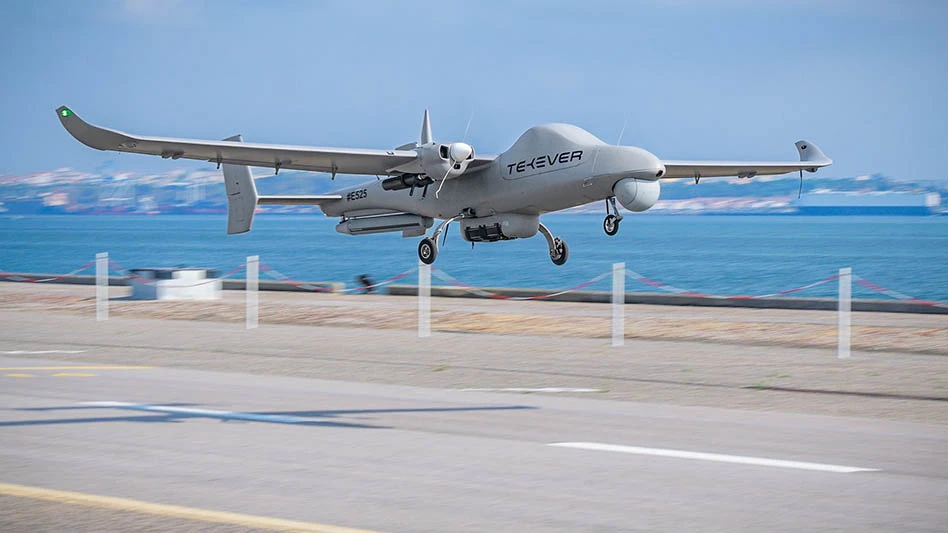
- AR3: The workhorse. A small, long-endurance fixed-wing ISR drone built for contested environments. The AR3 has logged 10,000+ flight hours in Ukraine.
- AR3 EVO: The newer, more modular AR3. Adds precision VTOL, including from ship decks and unprepared terrain, while retaining fixed-wing endurance.
- AR5: ISR, but bigger. A 20-hour, 50 kg-payload platform for persistent land, border and maritime surveillance.
- ARX: The big autonomous mothership. A 150 kg payload, with up to 30 hours endurance and 1,000+ km range, with onboard AI and SATCOM. It’s designed to coordinate multiple other drones for collaborative autonomy and swarming.
- AR6: The heavy-lifter—and TEKEVER’s push out of ISR. It’s designed to haul 200 kg over 500 km for things like resupply and autonomous logistics, and production is slated to start in the UK by the end of 2026.
All of this runs on ATLAS, TEKEVER’s AI-powered intelligence and mission-management platform. Gotta honor those software roots, after all.
Firm handshake: And the company has notched some pretty major wins lately, contract-wise.
- Earlier this month, they signed a deal worth up to £400M over 10 years with the British Army for Project CORVUS. The idea is to bring the AR5 into service as the Army’s new persistent deep-ISR drone, replacing Watchkeeper. Initial order is six aircraft, scaling to as many as 24 by 2029.
- They were also selected for the British Army’s Project NYX (autonomous Apache loyal wingman) alongside Anduril, BAE, Leonardo, Lockheed, SYOS and Thales.
- The AR3 is also the frame for the Royal Air Force’s (RAF) first Autonomous Collaborative Platform, designed to fly alongside Typhoons and F-35s, and the RAF invested an initial £19M in the capability last year.
- Plus, there’s all the ISR stuff—they’re on contract with the Brits, the Portuguese, the Ukrainians, and the EU for good ol’ eye-in-the-sky capabilities.
Stars and stripes: The company says it plans to use this new funding to “execute its strategy, deepen its international presence, expand its industrial and technological capabilities, accelerate strategic acquisitions and build on its position as the leading European technology company in AI-powered autonomous systems.”
- Particular focus seems to be on the US—which tracks, given the UC investment. Worth noting this is the $190B endowment fund’s first direct check into Europe.
- And the money ain’t stopping here. The company says it “expects to complete additional closings of the Series D over the coming months to bring onboard new strategic investors.”
“TEKEVER has built an exceptional technology platform over more than two decades with a proven record of operational success,” Jagdeep Singh Bachher, the University of California’s chief investment officer, said in a statement. “Our conviction rests on Ricardo and his team, and on the growing weight of European technology in global markets.”