Over the course of America’s war with Iran, Iranian drones and missiles have hit US radars, aircraft, and the most critical of critical infrastructure in the age of AI: data centers.
Russia, too, is increasingly targeting Ukraine’s data centers, “seeking to disrupt the flow of information,” Ukrainian foreign minister Andriy Sybiha wrote on X.
Those attacks, and their ever-growing importance in military operations, are forcing militaries to look into putting data centers in the only place they can be kept safe in a conflict—underground. Two startups are teaming up to make that happen.
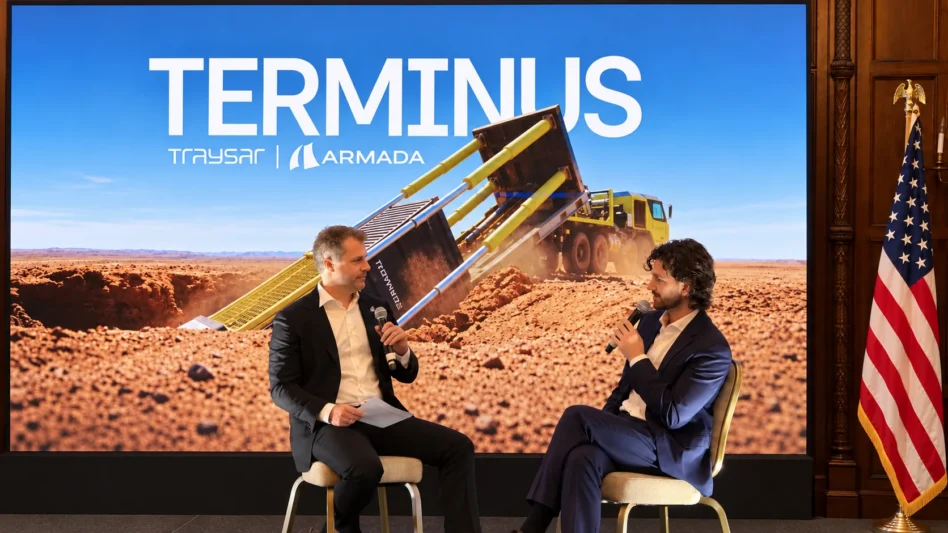
Down below: On Wednesday, subterranean defense startup Traysar and defense-focused edge computing startup Armada announced a partnership that’ll aim to burrow Armada’s containerized data-center-at-the-edge underground using Traysar’s newly unveiled truck-mounted boring platform.
“Everyone’s talking about resilience because of what’s happening in the Middle East, but Armada’s been talking about it from a different angle, which is building modular compute so you don’t have one point of failure, which has tremendous value in war zones,” Traysar co-founder and CEO Yadin Soffer told Tectonic. “We add a whole other layer of resilience here, which is that your assets can’t get hit. Not only are they protected because they’re distributed—now they’re also literally protected beneath the crust of the earth.”
Makes sense.
Making boring not boring: With a $2.2B valuation, Armada’s a known quantity in the defense world, but Traysar is more stealthy. One reason is that they’ve been hiding out underground. The Austin-based startup, which emerged from stealth with $25M in seed funding in June, is on a mission to develop the ”technological solutions to enable US military supremacy in the subterranean domain.” That includes:
- A truck-mounted cylinder-shaped Tunnel Boring Machine (TBM) called Terminus that can dig a hole underground to deliver anything from signals intelligence systems to munitions and, well, containerized data centers.
- And an “excavator-class underground autonomous system,” which pretty much “looks like a tiny tractor, about 30-40 inches in diameter, but with the force of a full-size tractor and operates in a tunnel, and demolishes it from the inside out,” Soffer said.
The first platform is what this partnership is all about. Terminus is still under development, but Traysar wants to have it operational in the next “six to eight months.”
Spread out: On the Armada side, their containerized data center is bolstered by the company’s new Sovereign AI Grid, which “basically turns all of these nodes into a network where workloads can run on one, and then if there’s ever a threat against a node, whether it’s a cyber threat or a physical threat, you can just back that up, run that same workload on a different node,” CEO Dan Wright told Tectonic. “It’s distributed, extremely hard-to-kill infrastructure, and this is the next natural evolution. How do you make that even more difficult to disrupt so that your critical workloads will always just run? The best way to do that is to put it underground.”
“The partnership with Traysar just allows us to take it to the next level in terms of the overall resiliency and how we’re actually seeing these conflicts evolve,” he said. “It’s actually happening now that [critical infrastructure] is going underground, and I think that’s only going to continue. Obviously, it’s less vulnerable because you can use the Earth’s crust as a shield, but it’s also much harder to detect by satellite.”
Delivering down under: For Traysar, Armada’s mini data centers are just one platform they’re looking at delivering underground.
“Containers these days can be almost anything, and it’s a form of critical infrastructure. At some point, it can even be nuclear reactors; it can be data centers, it can be [with] a company like Firestorm building 3D printers,” Soffer said. “If you have the capability to protect something the size of a shipping container, it just unlocks a lot of expeditionary capabilities.”
Maybe Palmer Luckey is onto something with his take that “the subterranean domain will be the defining [warfighting] space.”