Last year, Palmer Luckey said that he believes “the subterranean domain”—rather than sea, air, or space—“will be the defining [warfighting] space, but nobody agrees with me, and every time I talk about it I sound insane to people.”
He also said that “a vehicle that moves through the crust of the earth is going to be a huge deal,” and Anduril even has a blank page on its website that simply says: “Some interesting things happen once you can control the crust of the earth.”
Luckily for Mr. Luckey, an Austin-based startup has secretly been working for the past year to prove him right.
At the Reindustrialize Summit in Detroit last week, Traysar Industries emerged from stealth with $25M in seed funding led by Silent Ventures and a mission to—in the words of CEO Yadin Soffer—develop the ”technological solutions to enable US military supremacy in the subterranean domain.”
- Lux Capital, Ora Global, and angel investors, including Steve Blank, and founders from Anduril and Erebor, also joined the round, alongside NeverLift VC, Mana, Impatient Ventures, New Vista, and Entree Capital.
- Asked if Luckey is an investor, Soffer said “no comment.”
Land down under: If you’ve been paying attention to how wars have been fought in the Middle East and Ukraine, the logic of taking defense tech underground is pretty clear. Hezbollah, Hamas, and their Iranian sponsor have built vast tunnel networks for everything from weapons storage and transport to command posts, troop mobility, and more. Ukraine, given the ubiquity of the drone threat from above, has similarly moved much of its warfighting infrastructure underground.
Despite that, there hasn’t been much focus on developing the tech to control the subterranean domain. Out of sight, out of mind type of thing.
“The main reason [for that] is that there’s no clear funding for it, and that’s risky—that’s risky to the venture markets, risky to a lot of different markets,” Soffer told Tectonic on the sidelines of Reindustrialize. “But we said, ‘F*ck it, we’re doing it,’ and that was how we started the company.”
Molehunters: Traysar’s mission also makes sense given the startup’s origin story. The founding team consists of:
- Soffer, who moved to New York from Israel eight years ago to found a fintech company that later sold to Ipsos;
- Asher Katz, who served in an Israeli military unit dedicated to “identifying terror tunnels crossing into the country,” called the Lab for Tunnel Detection;
- And Gilad Adin, a former Israeli military and foreign affairs advisor.
Traysar’s tech: Over the past year, the founders and a team of engineers from Anduril, The Boring Company, and SpaceX have built two working technologies dedicated to solving different parts of the subterranean problem:
- An “excavator-class underground autonomous system,” which pretty much “looks like a tiny tractor, about 30-40 inches in diameter, but with the force of a full-size tractor and operates in a tunnel, and it demolishes it from the inside out,” Soffer said. “Solutions like this are so critical because of the 700 miles of terror infrastructure in Gaza, and many, many miles of cartel infrastructure underneath the US borders.”
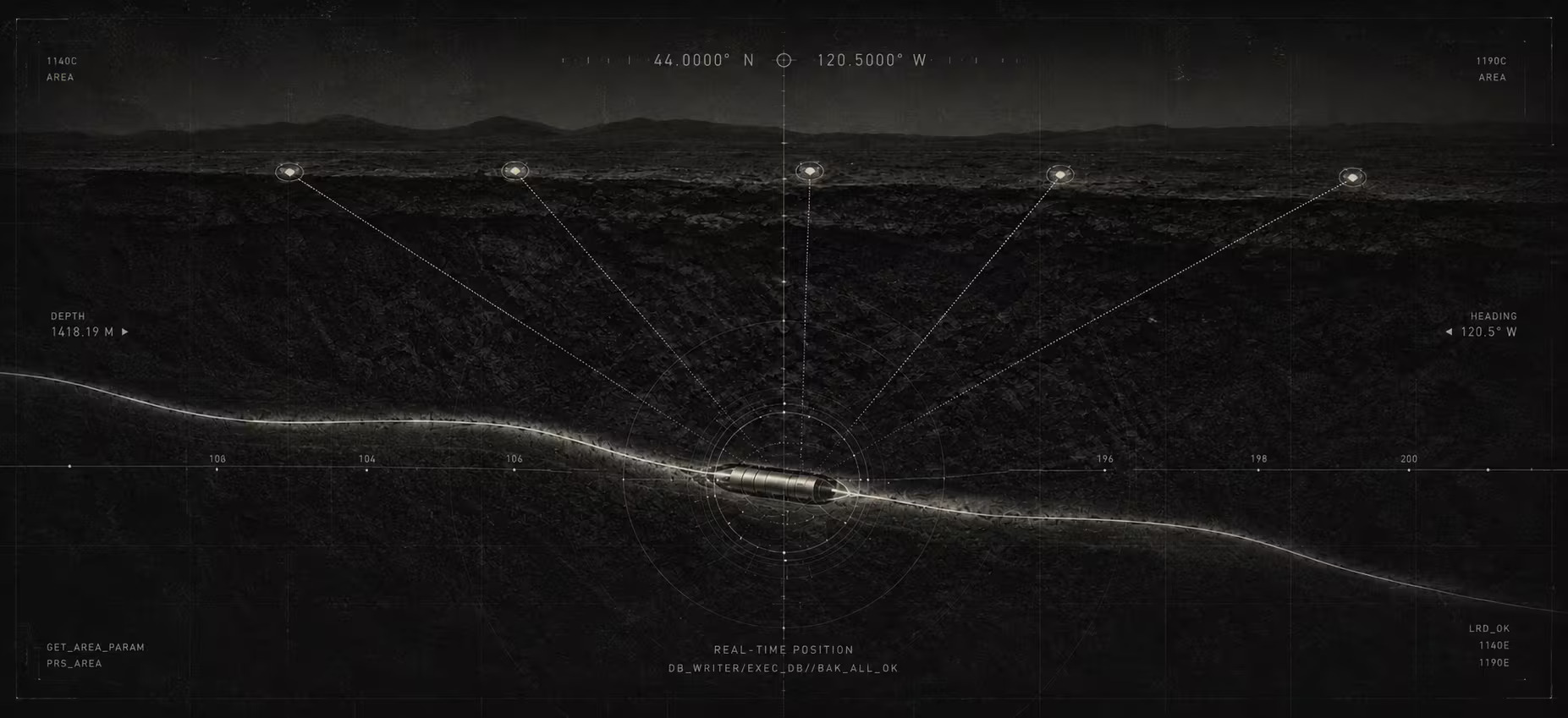
- And a cylinder-shaped system “resembling a Tunnel Boring Machine (TBM)” that can “dig a hole underground, can be deployed from a tiny container anywhere, and carries behind it a train of explosives or a train of signals [collection technology] for continuous monitoring,” he explained. “I think the second class sparks the imagination more, when you’re talking about the subterranean defense company.”
According to Soffer, the first form factor is actively deployed in Israel through the country’s equivalent of the DIU, and Traysar held its first munitions test of the second in mid-April.
Burrowing bucks: With the $25M in seed funding, Traysar is focused on deploying the capital “towards sales broadly, a lot towards policy, a lot towards government,” he said. “Our entire team is engineers, and we have absolutely no sales, no marketing, none of that,” and Traysar needs to fix the subterranean “branding issue” so people identify it as a critical domain of conflict alongside “air, land, sea, space.”
That’s important, because, beyond the Middle East, in a “situation with China, the sky will be a contested environment. No one will win the sky, no one will be able to operate above ground, so the battlefield goes below, and the asymmetric advantage that we can create underground is how we win wars,” he added.
“The defining warfare category of the next century is not what everyone’s thinking, it’s not space—it’s the subterranean domain; it’s what’s happening beneath our feet.”