It’s Day One of the Air, Space & Cyber Conference, and Swarm Aero is kicking things off with a bang.
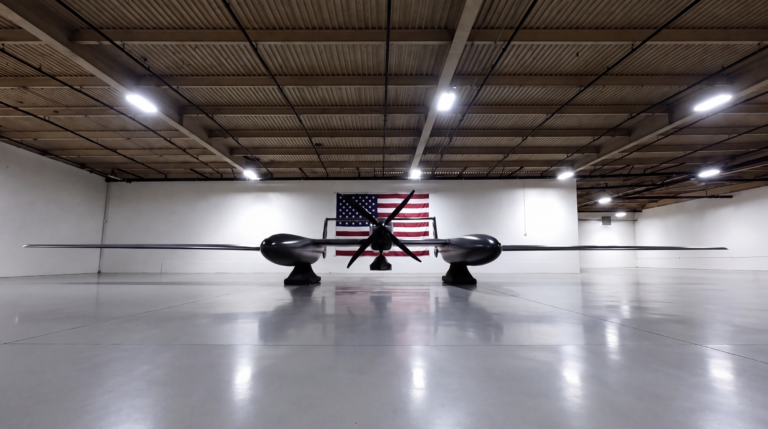
This morning, the California-based startup unveiled Gamera, the Reaper-sized Group 5 drone it’s been quietly developing since 2022 with an eye on the Air Force’s Massed Modular Aircraft program.
And according to Swarm, the big-boy drone—we’re talking 72-foot wingspan big—will pack a heck of a punch when it’s flight-ready, potentially as early as next year.
- Swarm says Gamera—powered by Honeywell Aerospace’s TPE331 turboprop engine—will have a mission radius of over 2,500 miles, a payload capacity of 2,800lbs (including JASSM-ER-class long-range strike munitions), and the capability to “self-deploy over 8,000 miles at a cruise speed of over 200 knots.”
- They’ve also built the collaborative autonomy software (called Legion) to power swarms of the big drones, which they tested on everything from “Group 5 UAS to expendable platforms” during a Navy exercise earlier this summer, but it can run on other autonomy software as well.
“Since 2022, we’ve been quietly building [Gamera] and maturing all aspects of it: the design, the manufacturing processes, the command and control,” Swarm co-founder and CRO Oliver Palmer told Tectonic. “We put tens of millions of dollars and many years of effort into maturing each one of those areas.”
Big buzz: All that effort isn’t for nothing. Swarm’s pretty much purpose-built Gamera for the Air Force and DIU’s Massed Modular Aircraft program, the service’s push to find and field a replacement for the workhorse MQ-9 Reapers that are in increasingly short supply.
- For the MMA program, the Air Force is looking for unmanned aircraft with an unrefueled combat radius of 2,300 nautical miles, a range of 8,000 nautical miles, and a payload capacity of 2,800lbs.
- All that capability should come in at around $10M a pop—about half the expected price for CCAs and a third of the price of a Reaper. “At volume, [Gamera] can definitely be below $10M, and we’re very competitive on price,” Palmer said.
- The Air Force wants to get those big drones flying as early as 2029, with plans to ultimately field at least 180.
The DIU’s MMA solicitation was posted earlier this summer, but Swarm Aero’s been building around this idea for years.
“The thesis has really been that long-range, high payload capacity, but very low-cost aircraft could have a tremendous impact on power projection, and specifically the kind of pressing scenarios around stopping Chinese power projection [around] Taiwan,” Palmer said.
Heating up: Palmer also sees those years of development as Swarm’s key advantage over competitors—including the Reaper’s manufacturer, General Atomics (GA-ASI), which unveiled its bid for the MMA program last week.
- GA-ASI’s Wildfire drone, according to the company, “will be highly autonomous and designed for collaborative operations on Day One.”
- The mega-prime also thinks they can deliver it “years earlier than the FY2031 timeline defined by DIU, producing more than twice as many aircraft in the same amount of time,” thanks to their manufacturing footprint and sprawling supplier network.
Swarm isn’t too worried about a little prime-startup competition, though.
“As with most technology, there’s an iteration and a learning loop—whoever can complete that the fastest and get the furthest through it ultimately builds the best product,” Palmer said. “We’re just way further along on that than anyone else, and we move through those loops very fast.”
“There are things we know about why designs should be the way they are—and the optimization points of what really matters—that are going to take other people years to figure out,” he added.