The Pentagon’s framework agreements with Lockheed to triple and quadruple Patriot and THAAD production (respectively) made a big splash, but it looks like the department heard that those numbers would be pretty hard to hit if production of their key components didn’t get some love, too.
Luckily, they’re moving to fix that missile pickle. Yesterday, the Pentagon announced two “landmark seven-year framework agreements” with L3Harris to boost production of key components for the Patriot and THAAD interceptors that are in increasingly short supply, including their rocket motors and maneuver systems. The deals cover:
- The two-pulse solid rocket motor, Attitude Control Motors, and the Lethality Enhancer (which increases the PAC-3’s kill radius) for the Patriot;
- And the SRM that launches the THAAD interceptor and the Liquid Divert and Attitude Control System, which maneuvers it in flight.
The company and the Pentagon didn’t include any numbers, but they’re probably aiming to keep pace with Lockheed’s production boost and banking on securing the contracts down the line to fund it.
We’re beating a dead horse at this point, but here’s why these deals are important (if they end up materializing). Patriots and THAADs snag the headlines, but their components—especially SRMs and seekers—are often the underappreciated chokepoints that slow the deliveries to a snail’s pace. There are pretty much two primary SRM manufacturers (L3Harris is one), and the startups looking to shake things up need a little more time to get things going (and are starting on smaller systems than the PAC-3 and THAADs).
Feeling Patriotic: The Lockheed-made Patriots, formally the Patriot Advanced Capability-3 (PAC-3) Missile Segment Enhancement (MSE), are ground-launched interceptors designed to target aircraft and ballistic and cruise missiles. 18 countries use them, and roughly half of the annual production goes to allied militaries.
Given the rate the US is burning through them in Iran, that’s becoming a bit of an issue, to say the least.
- The US had a pre-war inventory of about 2,330 Patriots. Between 1,060 and 1,430 of those have been used in the Middle East.
- That supply is even more strained by a 42-month delivery timeline and a production rate of just 183 Patriots per year.
- However, Lockheed has kicked things up a notch, delivering a record 620 of ‘em last year after a 20 percent year-over-year production increase, but that’s still falling well short of demand.
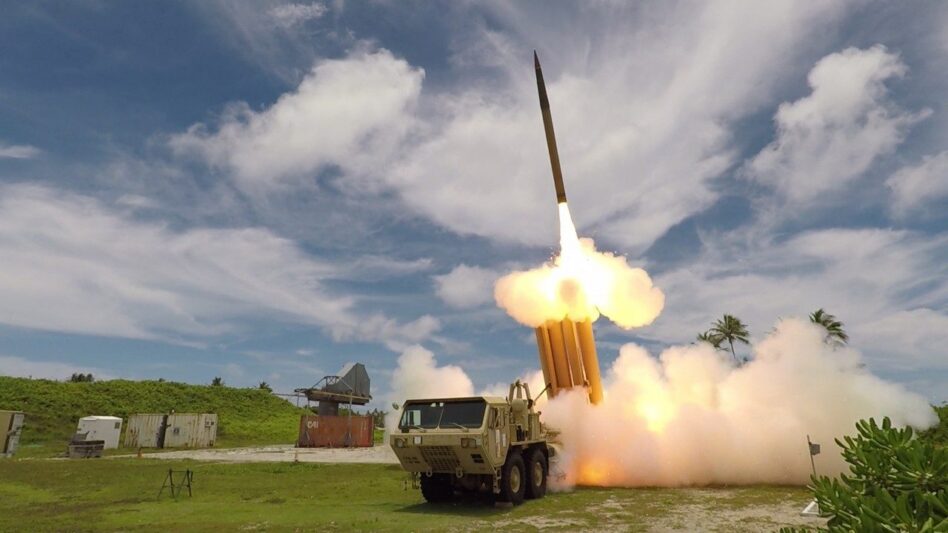
Summertime THAADness: Lucky for Lockheed, they also make the even more pricey and sought-after THAAD interceptors—the crème de la crème of the Pentagon’s interceptor arsenal. They’re designed to take out ballistic missiles at a longer range and higher intercept altitude than the Patriot (including exo-atmospheric targets), and the US has also been running through them in the Middle East.
- America’s pre-war inventory numbered just 360, and that’s been cut down by between 190 and 290 in Iran (150 of ‘em were used during the Twelve-Day War alone), per a recent CSIS report.
- Critically, the US has only eight THAAD batteries and currently produces just 96 interceptors per year. Each interceptor costs a whopping $15.5M, compared to the less fancy Patriot’s $4M per-missile price tag.
- Even more critically, the delivery timeline for THAAD interceptors is 53 months, and there have been no new deliveries since mid-2023. That’s expected to resume by next April.
Math ain’t mathing: Those numbers are pretty scary, and the Pentagon is moving quickly to push industry to ramp up production, including ahead of contracts. Over the past few months, the Pentagon has inked a flurry of “framework agreements” with Lockheed and component manufacturers (like L3Harris) to replenish its interceptor arsenal.
- Under the (fairly abstract) deals, Lockheed agreed to triple Patriot production from 600 to 2,000 by 2030, and quadruple THAAD production from the current 96 to 400 a year.
- To mitigate foreign (especially European) demand for Patriots, Lockheed also rolled out a Patriot-on-a-budget, called the PAC-3 ACE, last week, which it says will come in at around “a third of the cost” and cover about “two-thirds” of the area the current MSE variant defends.
- The Pentagon inked a deal with Honeywell Aerospace to boost production of navigation systems and maneuverability actuators that guide the interceptors (among other precision munitions). Honeywell is investing $500M to expand production capacity to meet demand (again, ahead of contract).
- Boeing is also ramping up Patriot seeker production—another critical bottleneck, along with the solid rocket motors—to 850 this year, after increasing production from 400 to 650 last year.
Again, all of these framework agreements are pretty much handshake deals that depend on the actual cash getting appropriated by Congress, but it looks like everyone’s betting that by the time it is, the primes will be better positioned to deliver before the next war.