
Allen Control Systems certainly isn’t resting on its laurels after raising $200M at a multi-billion-dollar valuation.
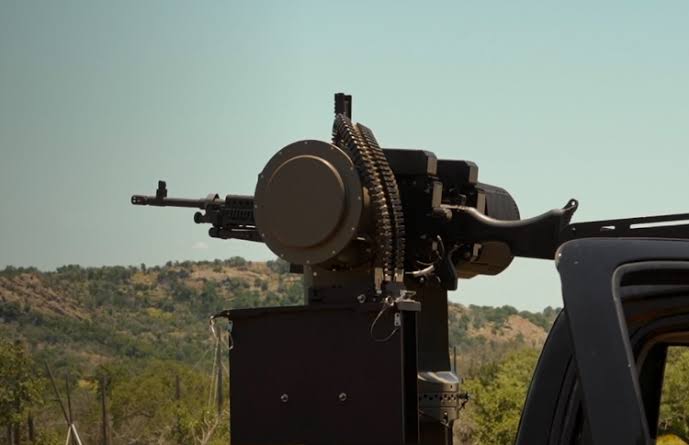
The Austin-based counter-drone startup announced this week that the Marine Corps has selected its Bullfrog robo-machine gun for the Light Marine Air Defense Integrated System (LMADIS), the service’s most expeditionary vehicle-based c-UAS platform, under its broader Ground Based Air Defense (GBAD) program.
Pew-pew: By now, ACS should be a familiar name around these parts.
The company’s flagship Bullfrog autonomous turret, which uses AI and computer vision to identify and track aerial targets and a standard M240 machine gun to shoot ‘em down, has proven pretty popular with US and foreign customers looking for a low-cost-per-kill drone-downing solution.
- In addition to the Marine Corps, the company has secured over $120M in contracts for Bullfrog with USSOCOM, the Navy, Army, and allied militaries, including the UAE and South Korea.
- The platform itself is also pretty versatile: it can be fitted onto pickup trucks, USVs (they partnered with Red Cat’s maritime division, Blue Ops, in March), or fixed sites, and the turret and gimbal can “wield any kind of different effector or sensor autonomously,” CEO Mike Wior told Tectonic last month.
- They’ve built it to focus on the small and speedy Group 1 quadcopters, but ACS says Bullfrog can take down larger ones, too. “If [Bullfrog] can shoot a seven-inch, fast-maneuvering drone, we can absolutely target critical components on a larger drone,” Wior said, and it has “demonstrated success taking down Group 3 drones.”
That versatility is just what the Marine Corps is looking to add to LMADIS, the lightest and most mobile element of its GBAD program.
The Good, GBAD, and the Ugly: LMADIS, which fits under the broader GBAD program (which the Navy requested $1.27B for in FY2027), is the light variant of the larger MADIS platform, a mobile, short-range, ground-based air defense system designed to protect dispersed Marine units from UAVs, low-flying, high-speed fixed-wing aircraft, and helicopters.
- MADIS is composed of two Joint Light Tactical Vehicles (JLTVs), one focused on neutralizing fixed and rotary-wing aircraft with a turret-launched Stinger missile pod and a 30mm cannon, and the other on providing radar detection and C2 for the duo.
- LMADIS was rolled out a few years ago as an interim c-UAS stopgap solution before the full MADIS solution was fielded (the first delivery took place in Japan last month).
- It’s built on two Polaris MRZR lightweight tactical vehicles, and like the larger MADIS system, one is the “brains” (the C2 and detection) and the other brings the “brawn,” to quote the Marine Corps, with a suite of EW capabilities focused on small drones.
- The platform’s small size also enables “LMADIS to deploy to austere environments via air transport,” according to the service.
- Under the $1.27B GBAD ask in FY2027, the Navy requested $969M for the MADIS Family of Systems, which includes MADIS and LMADIS, according to budget documents.
Mad Dog (L)MADIS: Under the initial OTA contract—valued at roughly $6.2M—ACS’s Bullfrog, which can fire 850 rounds per minute, is bringing a bit more brawn to LMADIS than the EW tech currently on it, “increasing lethality and restoring maneuver for Marines on contested battlefields,” the company said in a statement.
“The Marine Corps requires the most sophisticated and accurate possible capabilities to carry out its critical missions,” Wior said. “We are honored to support Marines with fast, scalable, and cost-effective counter-drone solutions that integrate seamlessly into existing platforms.”