The Reindustrialize vibes are high, and business is booming for the companies building the factories of the future.
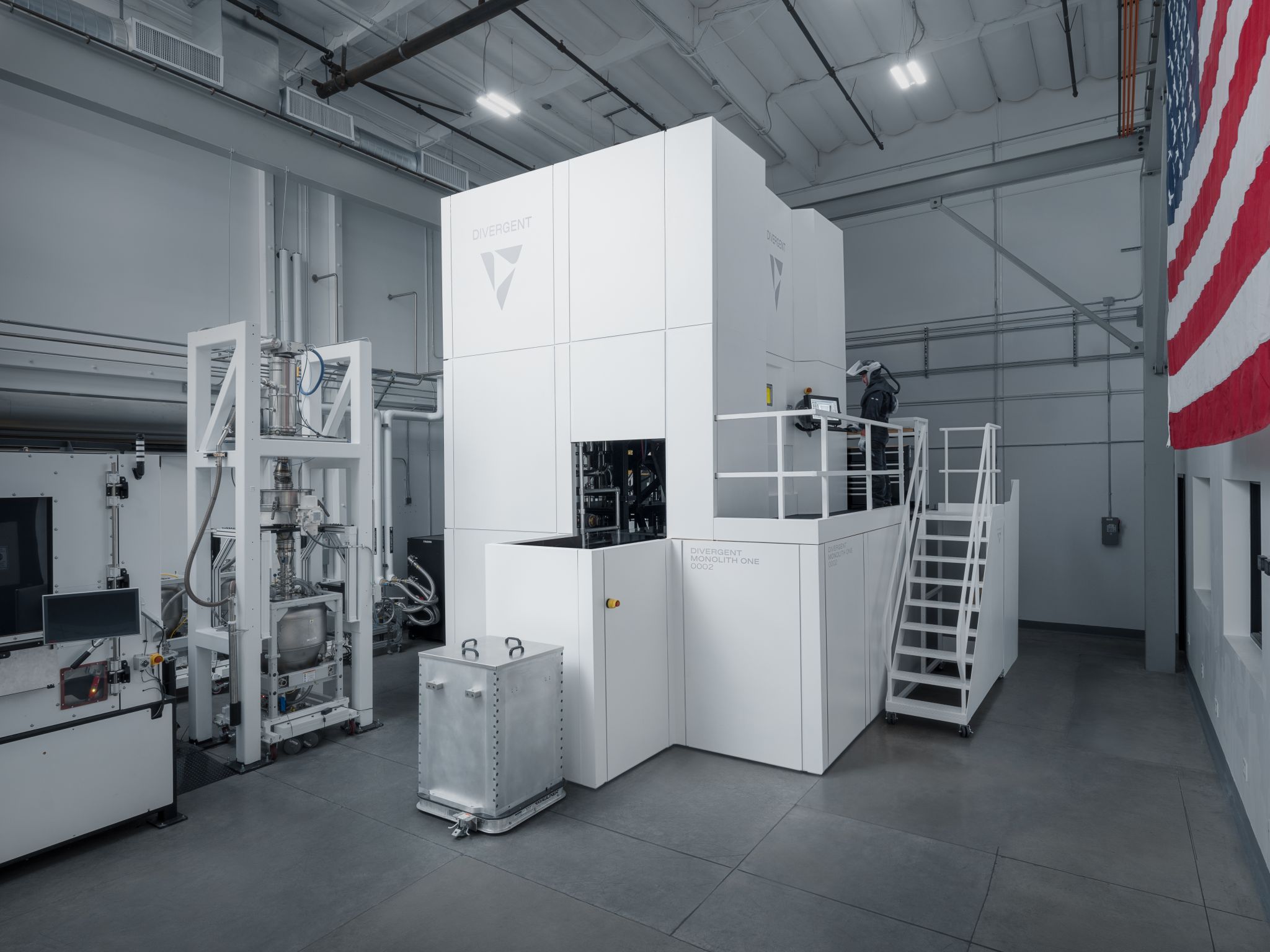
At the eponymous conference in Detroit yesterday, defense-focused advanced manufacturing startup Divergent came out swinging with two big announcements: They’ve designed and built a massive 26-foot-tall metal 3D printer called Monolith One, and they’re putting 64 of ‘em in their new 430,000 square foot facility in Long Beach, CA, within the next two years.
The company’s new printers—six of which are already up and running at their Torrance facility—and expanded manufacturing footprint are expected to deliver an eightfold increase in annual production output for a range of defense programs.
- The Monolith One printer—26 feet tall and 20 feet wide—is a laser powder bed fusion (LPBF) printer that uses high-powered lasers to selectively melt layers of metal powder, fusing them to build solid 3D structures. It’s compatible with industry-standard alloys like aluminum, nickel, steel, and titanium.
Printer go brrr: If you haven’t heard of Divergent, your favorite defense companies have.
While companies are stealing headlines with flashy next-gen missiles, drones, and USVs, Divergent is working behind the scenes, printing a whole bunch of their airframes, parts, and whatever other metal structures you can think of through their in-house-designed and built printers and AI-powered engineering and design software, called DAPS.
Divergent CEO Lukas Czinger told Tectonic that they work with pretty much every prime, and their new factory—kitted out with dozens of the giant Monolith One printers—will focus on printing airframes and parts for some of the Pentagon’s highest-volume missile programs.
- The company said the 64 printers will be able to deliver over 275,000 piece parts, over 30,000 500lb-class missile airframes, and over 60,000 100lb-class warhead casings, among other metal structures.
- “There’s already clear validation of the machine—we’re already achieving about 2X the throughput on Monolith One versus the legacy machines we have,” Czinger said. “2X the throughput means we can produce lower cost, and we can therefore offer better pricing to our primes and our OEMs, which makes us more attractive to the military at large.”
“The big programs that are going through [Monolith One] are the airframe for CoAspire’s [Rapidly Adaptable Affordable Cruise Missile, or RAACM] system, which is continuing to ramp in volume and we think will turn into multiple programs,” he added. “We’re working on the full Family of Affordable Mass Missiles (FAMM) and Low-Cost Containerized Missiles (LCCM) list of programs across the industry as well.”
- Last month, the Pentagon inked deals with CoAspire, Anduril, Zone 5 Technologies (now a Kongsberg subsidiary), and Leidos for the LCCM program, with the goal of fielding more than 10,000 low-cost cruise missiles over three years. Czinger said they’re working with “multiple players” in that program.
- On the FAMM front, the Air Force is planning to buy 28,000 over the next five years, according to the service’s FY27 budget documents. Production is set to kick off later this year, with Anduril, CoAspire, and Zone 5 serving as the known prime contractors.
- They’re working with Raytheon and the Navy to print the six-foot-long “mid-body” of the Tomahawk, which they’re “going through qualification of right now and producing a lot of units.”
Czinger said that “there are a huge number of upcoming programs” that they’ll announce soon and will “get into full production on,” and that Divergent has “started getting into interceptors,” too. “I can’t announce the name of the [interceptor] program yet, or the prime that we’re doing it for, but we think that’s going to be a good driver as well for us.”
“We’ve got some multi-year agreements, but we’re not flying as a prime against any other primes,” he added. “We’re waving the white flag of neutrality and being a force multiplier for every program across almost every US prime at this point.”
Like we said, business is booming.