In case you missed the memo, interceptors and low-cost missiles really are so hot right now. And it looks like that goes for our friends across the pond, too.
This morning, UK-based defense hotshot Cambridge Aerospace announced that it’s raised a $300M Series C at a $3.4B valuation led by DFJ Growth with participation from Lux, Accel, Lakestar, Never Lift, Ora Global, and Elad Gil & Co.
- DFJ Growth is new to the cap table—Elad Gil & Co and Spark Capital led the company’s $200M Series B in April. Yes, this April.
- Total funding now stands at well over $600M. Pocket change, ya know?
CCO Chris Sylvan told Tectonic that this (massive) pile of cash will be used to scale up production and expand worldwide. Makes sense, considering everyone and their mother needs more interceptors right now.
“There’s no piece of news that’s come out recently that doesn’t validate our thesis,” he said. “With vertical integration, with scaled manufacturing…with retaining the price point through that scaled manufacturing and vertical integration…Those three factors make both our products and our business as a whole exceptionally exciting and engaging for the customers that need it.”
Look out, y’all. The British really are coming.
Speedy quick: Now, Cambridge Aerospace has been on a lightning-fast ascent since it was founded back in 2024, but they’ve remained pretty quiet throughout. Probably a good thing when you’re building kit designed to take out things like Shaheds.
- The company was set up by Cambridge and MIT aerospace professor Steven Barrett, Anduril and UK MoD alum Chris Sylvan, and Junaid Hussain (who’s also helped found other defense companies like Agon).
- Cambridge’s central thesis is pretty simple: The team set out to build interceptors that were cheap enough (and fast enough, and quick enough to produce) to match a Shahed or a Geran. As we all know by now, it is really stupid to waste a Patriot on a $50K drone.
Out of this world: So far, the company’s building two main platforms:
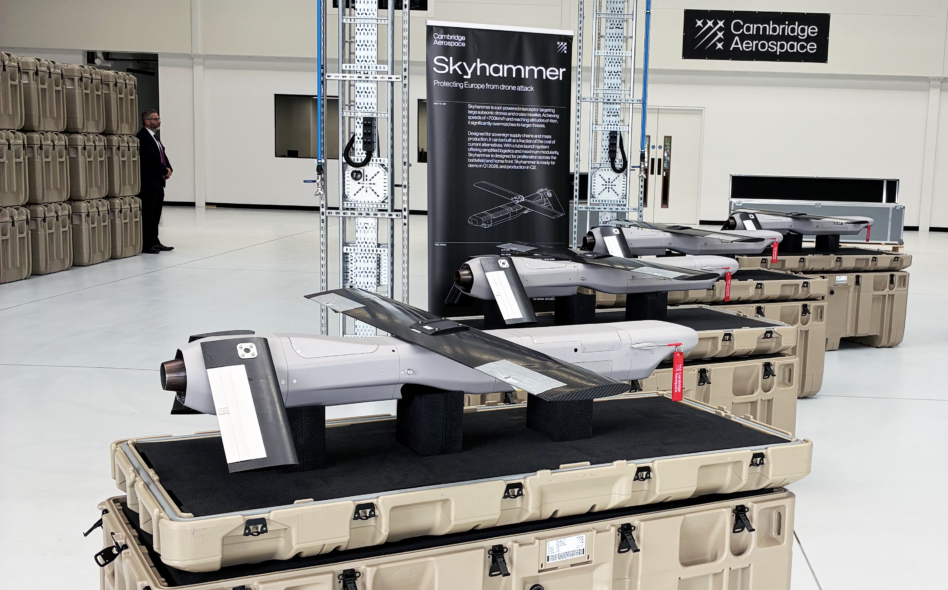
- Skyhammer: A “high subsonic interceptor” designed to take down moderate-speed threats (like those pesky Iranian drones). Skyhammer flies at 700km/h and has a range of about 30 km. This mini-missile is in production and on contract with the MoD.
- Starhammer: A high-speed rocket-powered interceptor designed to take down more “high-speed, high-value threats” like cruise missiles, Barrett said last year. Starhammer will fly at Mach 2 with a range of about 10 km. This bigger and badder interceptor is currently TRL 3-4 with flight tests planned for the back half of this year, per Sylvan.
Skyhammer is currently in operational evaluation with the MoD under the April contract and the Low-Cost Effectors & Autonomous Platforms (LEAP) program (which was announced in July).
- Speaking of cost—while Sylvan couldn’t tell us an exact price, he said they’re putting these platforms into the market “at between one and 2% of the mean price of a traditional missile.” Not too bad.
World tour: To date, the company has remained pretty laser-focused on the UK. But with this new round, they’re going all Mr. Worldwide.
“What this really allows us to do is expand our global footprint,” Sylvan said. “Germany, Poland, Ukraine, Nordics, Australia, the Gulf. It lets us meet demand from the customers that we’re engaging with.”
- The company will also build out its capacity in the UK to “meet [their] requirements for what the UK customer wants,” per Sylvan.
- Ultimately, they’re building the machine (manufacturing capacity) that builds the machine (the interceptor), he added. They will hire up and build out production capacity so they can produce these interceptors not in the tens or even hundreds, but in the “thousands and thousands and thousands.”
- With this money, the company will also push further into the “counter ballistic space…with Starhammer,” Sylvan said. “Bringing [Starhammer] to market, advancing the development of that capability and getting that into the [field] is going to be hugely important.”
“The idea of underinvestment in air defense has been a predominant reason for why Cambridge Aerospace has started and focused principally in Europe,” he added. “But lately, [our thesis] has been completely validated by everything that’s gone on in the Gulf. The Russians, the Chinese, the Iranians are not producing [fewer] Shaheds…So the need continues to grow for cost-parity and layered defense in this domain.”