If you thought that SRMs and propellant were the only way to launch stuff into the air, well, think again.
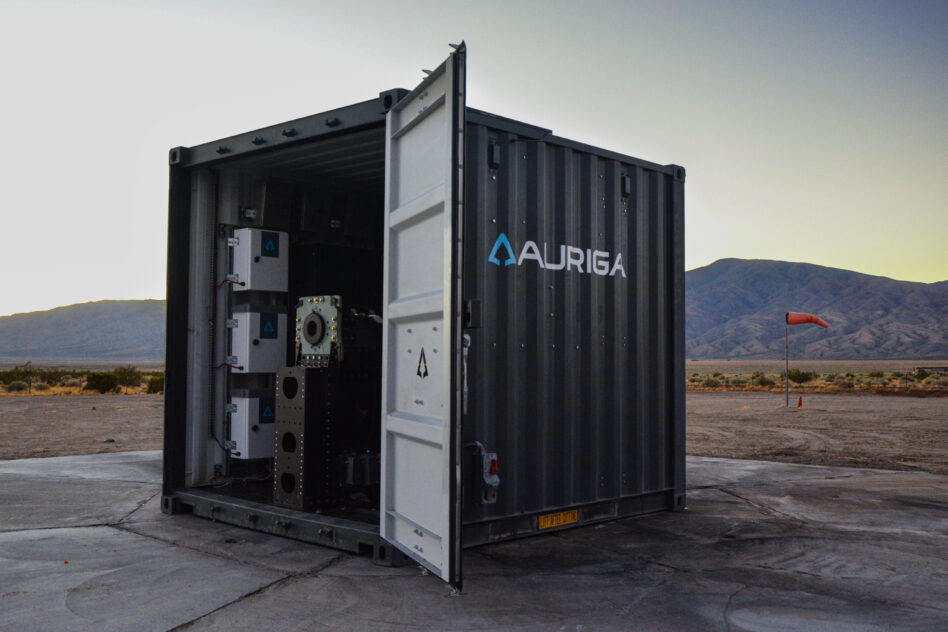
This morning, new-age launch company Auriga Space unveiled its new containerized Hermes electromagnetic launcher for drone interception and announced that they’ve already completed open-air testing of the system in the Mojave Desert. Basically, as we were all fretting over the munitions shortage, they were able to fire projectiles that could intercept drones using only electrical energy.
“We have been doing launches in our facility in Southern California—we’ve done over 1000 launches by now,” Auriga Founder and CEO Winnie Lai told Tectonic. “But the Mojave Desert demonstration was the very first time that we’ve done an outdoor launch…proving that we’re able to launch in an outdoor environment, [that] this shipping container is deployable [and] fieldable, and that it can operate on its own…as a standalone structure.”
And here we were thinking that all we needed to do to fix the, erm, interception problem was build more SRMs and whatnot. Leave it to the space people to come up with even more creative solutions.
Get outta here: Now, our friends who read Payload will be familiar with Auriga, but they’re a newer-ish entrant to the terrestrial defense side of things.
- The company was founded back in 2022 by Lai and set out to build a new-and-fun electromagnetic launch solution.
- Worth noting: Lai came from SpinLaunch, which is developing a similarly off-the-beaten-track giant centrifugal accelerator for launch.
- Auriga has raised about $11M in seed funding, according to Pitchbook data, and has won about $2.8M in contracts from agencies including MDA and AFRL, per Obviant.
Mount Olympus: You might be sitting there thinking, “Wait, what’s an electromagnetic launcher and why do I care?” Don’t worry, we got you: They’re basically very powerful linear motors that accelerate objects to extremely high speeds using electricity rather than rocket propellant.
- Think of Auriga’s core tech as an electromagnetic catapult—the company uses magnetic levitation and linear motors to drive a payload (or sled) along a track to super-super high speeds.
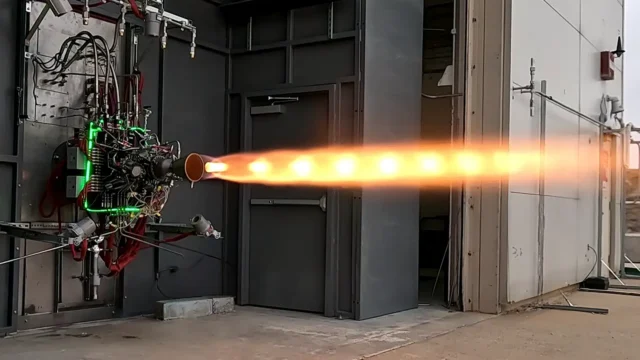
- Right now, the company has primarily focused on hypersonic testing—their current flagship product is Prometheus, a hypersonic launch test system that basically lets users accelerate things along that electromagnetic track to see how they perform in hypersonic conditions without, like, actually launching them into space.
- The company also says it is building a larger-scale launch system called Thor, Auriga’s larger hypersonic accelerator that it says will be online in the next few years. Prometheus can hit Mach 1; Thor is intended to reach Mach 5+.
The ultimate goal is to build an electromagnetic system that could actually launch things into space—Hermes (and this test) are another critical stop on that journey.
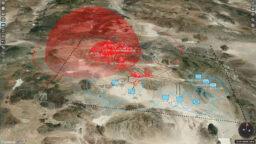
Watermelon Sugar: According to Lai, the Hermes test happened in the Mojave Desert under real, brutal weather conditions (she said it hit over 100 degrees Fahrenheit) and they used the containerized launch system to fire at everything from a stationary drone, to a glass plate, to a watermelon.
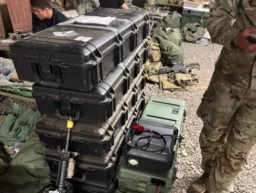
- With Hermes, Auriga has basically taken the electromagnetic launch tech underlying Prometheus and Thor and squished it down into a 10-foot shipping container.
- During the test, they completed “over a dozen launches at supersonic speeds above Mach 1, proving out the platform’s ability to fire in rapid succession while deployed in the field.”
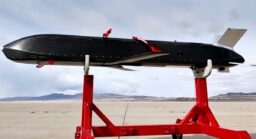
- Lai said that they fired a range of projectiles that they produced using CNC machines in-house. They’re smaller (and, frankly, a bit squatter) than your typical mini-missile interceptor, but they also don’t need a motor or propellant to get going.
- In the future, Lai said they’d also look to work with other companies to fire their interceptors using the EM launch system.
- For this initial test, the company shot at stationary objects at limited range to make sure the launcher, like, worked, but they’re planning to scale up this fall to “further demonstrate their capabilities.”
Big ups: Lai also said that they “also have the capability to scale the technology up for [larger-scale] missile defense.”
- Right now, based on modeling, Lai says the system should have the ability to take things down at a “multi-kilometer” range, but that will scale up quickly.
- From here, the plan is to take the learnings from the test (like, how wind affects Hermes and the projectiles, or how to optimize the set-up within the shipping container) and tweak the system.
- They’ve got a bunch more tests planned before the end of the year—including on the tech that could scale up to larger-scale missile defense.
“This is exciting for us given the market opportunity, but it’s [also] the ability to apply our technology to solve a problem that we keep reading about every single day in the news,” Lai said. “The war in Ukraine, the conflict in Iran, and how we keep running out of interceptors. Now, we have a solution that addresses that…we’re all very excited about the ability to contribute to the mission.”