We have a tendency around here to say that everyone loves a tiny plane. Well, as it turns out, there’s a lot of love for big ones, too.
Bay Area-based Poseidon Aerospace raised $60M in a Series A to fund flight testing and production of its cargo drone, Egret, and accelerate development of its seafaring sister aircraft, Heron.
- TQ Ventures led the round, with JAWS, G Squared, Hanwha Asset Management USA, Starship Ventures, Drover Ventures, Draper Associates, and other investors participating.
- The Series A comes about 10 months after the startup’s $11M seed round, bringing Poseidon’s total funding to over $70M.
Thinking big: Poseidon, as the name implies, launched in 2024 focused on building seaplanes for maritime contested logistics. After the seed round, they kicked off development of the wheeled variant, Egret, to go after a “larger market, bigger vision,” CEO and cofounder David Zagaynov told Tectonic. “There was no need to constrain ourselves to just seaplanes, so we’re doing all types of air cargo.”
For a relatively unsexy part of the flashy autonomous aviation world, the cargo-drone space—especially those focused on contested logistics—is busy, but Poseidon’s setting itself apart for two main reasons: First, rather than retrofitting an existing cargo plane for autonomy, they’re building the aircraft from the ground up; and second, they’re going big.
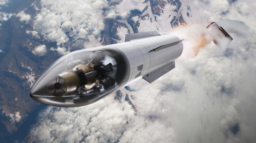
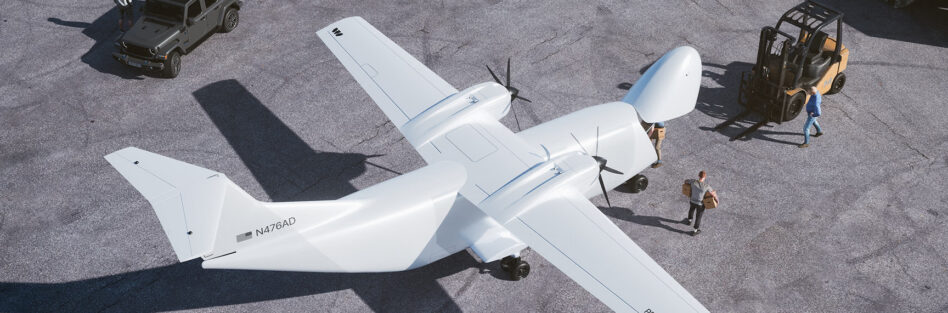
- Egret, which can take off from short runways (like those Pacific-flavored ones), has a 51-foot wingspan, a 1,650-nautical-mile range, a 4,000-pound payload capacity, and is designed for both nose- and rear-loading. Poseidon’s planning to have it in the air by the end of the year.
- Heron, the wheel-less seaplane variant of Egret, has the same specs, but is designed to launch from and land on “any body of water on Earth” (like that Pacific-flavored one). Poseidon’s flown smaller-scale versions of Heron, but a flight test of the full-size aircraft is coming after Egret.
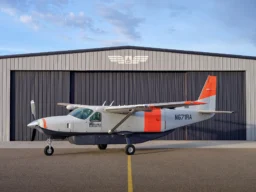
First principles: The thinking behind building all these aircraft from scratch— instead of putting an autonomy stack on an existing plane of similar size and shape (like a Beechcraft 1900 or Cessna Grand Caravan)—is that it can be purpose-built for autonomous logistics missions.
- Poseidon, unlike many other cargo-drone-makers, also isn’t trying to make things too complicated with VTOL capabilities. Heron and Egret are both fixed-wing and built around a standard combustion engine.
“These planes, designed in the ‘60s and the ‘70s, were built with passengers and pilots in mind,–and as a result, are designed around those requirements and specifications,” Zagaynov said. “When you remove all human life from the platform, you can fundamentally rebuild and redesign what it looks like, and that means that you can build a much lighter airframe that’s much more fuel-efficient and has a lot fewer subsystems.”
- “That means that the maintenance hours and costs are significantly lower—your engines are much smaller, they’re cheaper, they burn less fuel,” he added. “Plus, you don’t have a pilot and crew on board, which saves on those costs as well.”
- In other words, as he eloquently put it on X, “big drone move things cheap.”
Force multiplier: Now, Poseidon’s not trying to replace the US military’s fleet of C-130 Hercules, C-17 Globemaster III, and other mega-transport aircraft—which are many times larger than what they’re looking to bring to the table. Instead, they’re looking to become a “force multiplier” for these exquisite platforms, according to Zagaynov.
“The idea is that these platforms are able to free up our logistics capacity because, as of today, we don’t have enough,” he said. “In most contested environments, sending these platforms in means that we can create friction for red and optionality for blue because we are unmanned and these systems are a lot more attritable than, say, a C-130.”
- “It also allows you to disaggregate your cargo payload, so if we’re resupplying a bunch of nodes in a network, instead of flying one asset that has a 20-ton payload, flying 10 assets with two-ton payloads allows us to hit more places all at once,” he added.
Taking off: $60M in fresh funding will get Poseidon at least part of the way to fulfilling that vision (building planes ain’t cheap). “We were in prototype manufacturing for the first few assets,” Zagaynov said, and this new capital will go right into “building our first manufacturing line to be able to build these at rate, and taking Egret through the flight test campaign.”
We’ll see what the demand for Poseidon’s aircraft looks like after that, but “big drone move things cheap” is a compelling pitch.