Remember how we keep saying some of the most important, cutting-edge defense tech isn’t necessarily the flying, sexy stuff? Adyton’s here to prove our point, and it looks like the Army agrees.
The Dallas-based military operations software startup’s decentralized, peer-to-peer data fusion, communications, and inventory management platform, called Atlas, is rolling out on the Army’s API Marketplace, the company told Tectonic exclusively.
- That means any Army organization can now consume and plug into all the structured, real-time operational data—from troop locations to materiel inventory and reports—in Adyton’s network using an API credential.
- Adyton’s roll-out on the Army’s API Marketplace followed its integration with Anduril’s Lattice, which powers the service’s Integrated Battle Command System-Maneuver (IBCS-M) C2 and battle management system, at the Army’s Operation Jailbreak hackathon earlier this summer.
- The company also has a DoD-wide basic ordering agreement with the Navy and raised $11M in funding from Venrock, Khosla Ventures, Initialized Capital, and others last year.
Keeping track: What’s different about Adyton’s Atlas platform is its ability to run in comms-denied or degraded (aka DDIL) environments, thanks to its decentralized, peer-to-peer structure. In normal words:
- It connects people, devices, and systems directly in DDIL environments without requiring a cell tower, internet connection, or central server. The Atlas Network is the underlying, cryptographically secured network that everything flows through, and on top of that foundation, Adyton built an end-user-facing interface called the Adyton Operations Kit (AOK).
- Users tap into the platform via a mobile device and can see up-to-date info on the positions of people, teams, and assets; materiel inventory; and reports and task assignments disseminated down the chain of command.
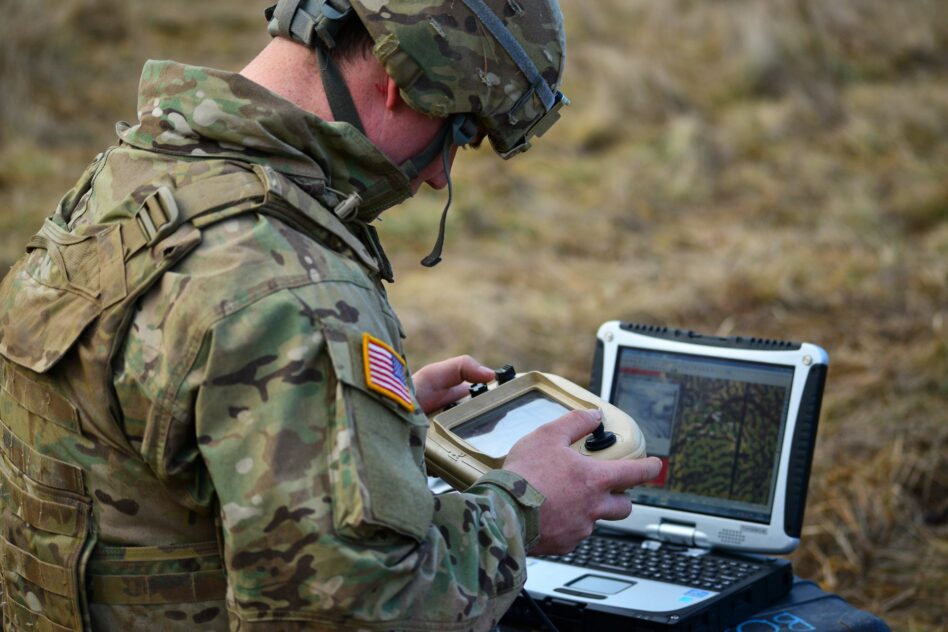
- For drone operations, one of Atlas’s most actively deployed use cases in the Army, the platform gives operators a live map of team positions, launch points, and strike results; real-time expenditures and quick resupply requests within the platform; and post-mission reports.
Bottom-up: It was first designed and rolled out for the lower echelons of the force, but they’re taking a bottom-up approach to moving up through the chain of command. Adding Atlas and AOK to the Army’s API Marketplace speeds up that growth and plugs it into Lattice, Maven, and other C2 systems the Army uses.
“If you want to solve the problem for the actual warfighter in the field, you have to be right there next to them, so our very first user was an E8 in the US Navy,” Adyton CEO James Boyd told Tectonic. “We’re driving meaningful expansion that started at the individual sailor level that’s worked its way up through the units and the chain of command.”
- Now, the AOK is deployed across tens of thousands of users, including “on three aircraft carriers in the US Navy, more Air Force units than I can name off the top of my head, and extensively inside the US Army Special Forces,” Boyd said.
All that’s important because, in the modern battlespace, “when a hostile force switches on jamming, it targets different frequencies in different places in different ways, and so what you end up with is just the comms lines go down in different places and at different times,” he said. “The core thing about peer-to-peer is, from a fundamental technology perspective, it enables you to take different pathways, enables you to work offline, and enables you to reconcile data offline… and when the communications go down, you can gracefully converge to a common understanding.”
By adding capability to the Army’s API Marketplace, it “gives [Atlas] tie-in interoperability” with other platforms and integrates that ground-truth data into “enterprise battle management systems like Lattice, or push it into enterprise systems like Maven,” Boyd added. “The key thing here is that you create this truth that’s shared across the front lines and is able to operate across this nasty communications environment, and then disseminate that truth up and down the chain of command and make it available to other systems.”