Well, gosh darn. We didn’t think we’d be writing so much about rare earths and metals as a defense tech publication but, well, here we are.
Yesterday, steel company (yes, we’re doing steel again) Hertha Metals announced that it’s raised a whopping $133.65M Series A to produce high-purity iron for domestic rare-earth magnets.
- The round was co-led by Khosla Ventures and Doerr Capital, with participation from CEV, Pear Ventures, Gates Frontier, Niterra SUISO no MORI Fund (General Partner: Global Brain), Toyota Ventures, and Siemens Financial Services.
- The raise includes a $65M investment from the US government through the Industrial Base Analysis and Sustainment (IBAS) program in partnership with the Economic Defense Unit.
Hertha Metals CEO and Founder Laureen Meroueh told Tectonic that the money will go towards building a new plant they’re calling Hertha Chalyx that will produce “high-purity iron and steel to address the US shortfall for rare-earth magnet manufacturers.”
“Every electric vehicle, aerospace platform, radar system, and data center depends on domestic iron and magnet feedstock suppliers,” she said in a statement. “Hertha Chalyx closes that gap.”
Short supply: Now, we’ve beaten like a dozen dead horses about the whole rare earth magnets problem, so we’ll keep this quick.
- Rare earth magnets—often from neodymium iron boron (NdFeB)—are found in everything from F-35s (900 pounds of rare earth materials in each) to nuclear subs (9,000 pounds) and drones because of their magnetic strength, thermal stability, and miniaturization capabilities. Put simply, they turn electricity into motion.
- China processes upwards of 90 percent of the world’s rare earths—the US currently clocks in at around 1 percent.
- The US government and Pentagon have majorly invested in developing rare earths mining, refining, and magnet-making capacity through investments in companies like MP Materials and magnet-maker Vulcan Elements.
- And that’s important—because (at least technically) those Chinese-produced magnets are going to be magneta-non-grata pretty soon. Congress prohibited the use of Chinese magnets in the DoD under the FY2021 NDAA, with the ban kicking in in 2027.
Despite the name, rare earth magnets aren’t actually made up entirely of rare earths—a lot of the actual substance is high-purity iron.
- Neodymium iron boron (NdFeB) magnets, for example, are roughly two-thirds iron by weight.
I’ve got the black lung, pop: But the problem is, the US has a pretty serious shortage of the kind of high-purity domestic iron ore needed for these magnets.
- Typically, magnet-makers need AISI 1001 very-low-carbon steel, which is in short supply in the US. Instead, they tend to export it from places like Germany and Brazil.
- It’s not that the US doesn’t have iron (and steel) production capacity—it does, typically dominated by massive companies like US Steel and Cleveland-Cliffs—but plants producing the high-purity stuff are limited.
“The way we’re making iron and steel in the US is not cost competitive anymore, and that’s primarily due to a lack of innovation and modernization,” Meroueh said. “How can we make iron and steel more cost-competitive without it just being a race to the bottom by cutting labor costs? That’s how China succeeds.”
New kids on the block: Hertha—founded by Meroueh back in 2022—is doing things differently.
- Worth noting: Meroueh is an MIT-trained mechanical engineer/materials scientist.
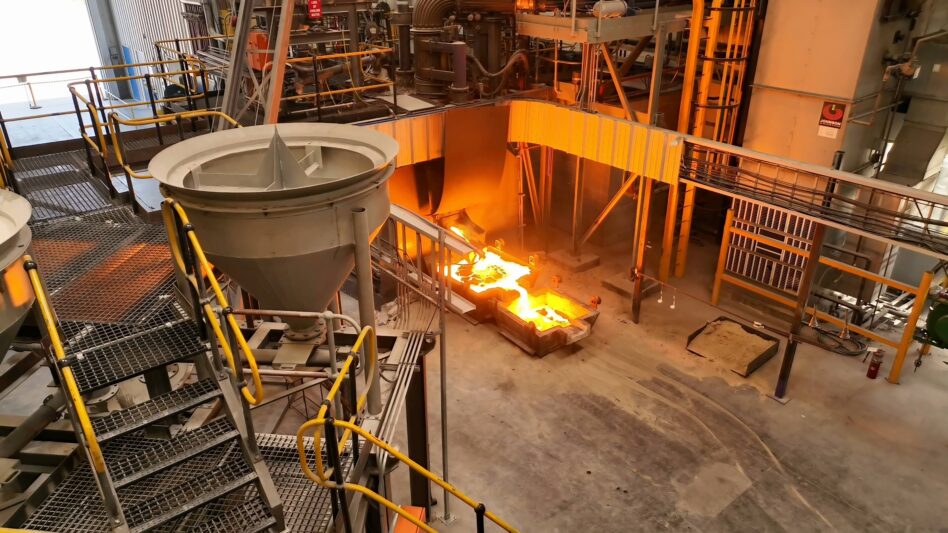
- They use a process called “Flex-HERS” to turn iron ore directly into steel or high-purity iron using a single continuous reactor (rather than the multi-step, coal-dependent blast furnace method).
- Per the company, this produces “iron and steel at 25% lower production costs than conventional blast furnaces, with emissions reductions of 50% using natural gas and up to 98% using hydrogen.”
- And they’re actually using it— Hertha has been operating a continuous 1-metric-ton-per-day (roughly 360-ton-per-year) pilot plant in Conroe, TX called Pi100 since 2024.
- Recently, the company demonstrated 99.95+ percent purity magnet-grade iron on its commercial-grade equipment.
This round takes all this and supercharges it.
- At full capacity, per Meroueh, the Chalyx facility will produce 10,000 tonnes of steel-grade and magnet-grade high-purity iron. Meanwhile, the company is also scaling up to a half-a-million-ton capacity for overall steel and iron production.
- Meroueh said they plan to break ground on Chalyx later this year, and that they will be “ramping up…[the furnace]” by Q4 of next year. It will be at full production capacity by the end of 2027.
- They’ll then install the second furnace (needed to make magnet-grade iron), and will start selling to magnet-makers by the end of Q2 2028.
“This timeline also aligns very well with the magnet producers themselves, who are also ramping up their production over the next two to three years,” she added. “I think that’s also something that makes this very special. Hertha Metals, uniquely, is on the same timeline for production as the current magnet manufacturers.”