Secretary Pete Hegseth has pledged to make the US military an “AI-first warfighting force,” and the Navy is taking that on board. Literally.
Yesterday, autonomy software giant Applied Intuition announced that the US Navy has tapped it to deploy a new AI-powered sensor fusion and data-collection system “across the manned and unmanned fleet,” starting with five Arleigh Burke-class destroyers.
- The initial contract value is $25M, awarded by DPRM Robotic and Autonomous Systems and PAE Mission Systems, a company spokesperson told Tectonic.
Applied Intuition’s system for kitting out those five destroyers has two main components: its Data Engine and Intelligent Perception System (IPS).
- The Data Engine, put simply, collects and curates operational data from onboard passive sensors during operations, which is sent back in near real-time shoreside to improve AI model training and perception capabilities in a continuous feedback loop, with a focus on training unmanned surface vessels (USVs).
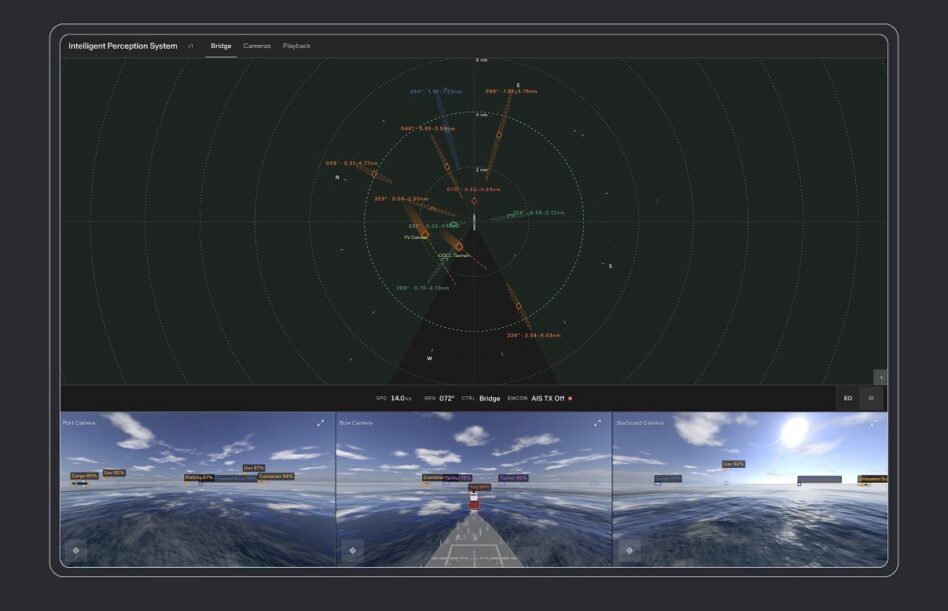
- IPS leverages the Data Engine onboard, integrating the infrared sensors and “camera systems with other systems on the ship, so that you can now begin to create what would be called advanced driving assistance systems in the commercial automotive world,” Applied’s Head of Product for Defense, Alex Campbell, told Tectonic.
- For IPS, that includes real-time detection, tracking, and classification; visual overlays and automated alerts for operators; and relaying all that data back through the Data Engine for model improvement.
- Applied is supplying both the hardware—new sensors, cameras, onboard compute—and software for this.
The first use case for IPS is giving bridge watchstanders—those folks responsible for safe navigation and ship handling—on the Arleigh Burke-class destroyers a single driver assistance-esque “screen that fuses all of that information together and gives [them] a more complete picture,” Campbell said. “This perception system coming from these cameras creates a more complete picture in a way that that data doesn’t get fused today.”
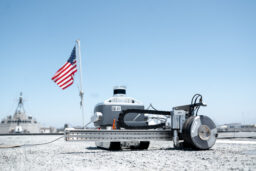
Suite Life on DECK: The production contract for the Data Engine and IPS grew out of Applied’s work with the Navy on the Data Edge Collection Kit (DECK) prototyping program, which created the Navy’s first large-scale computer vision data collection infrastructure.
- Applied delivered the DECK prototype earlier this year, but “in order to move really quickly, the DECK project was not integrated with other ship systems,” Campbell said, but the Navy said they “want to take it to the next level.”
- Now, he added, it’s getting integrated with the “ship systems to create a data engine foundation while simultaneously delivering value for a watchstander through the perception system.”
Ultimately, Applied wants to expand this beyond the five destroyers, and the production contract for this new data infrastructure will make that much easier.
“This is really setting the framework for how the Navy can frame requirements in the future, and frame them in such a way that it’s putting data first,” Campbell said. “That’s really how you start to unlock really exciting and really advanced features on a ship that was maybe built 20 years ago, and you can start to make things that have started to age into modern systems—that’s a huge deal.”