Looks like the whole reindustrialize wave ain’t over just yet.
Path Robotics, an Ohio-based robotic welding and physical AI startup, raised $300M in Series E funding led by Canadian VC giant Georgian, quadrupling its post-money valuation to $2.45B and bringing its total cash raised to a cool $610M.
As with the rest of the defense tech world, the rise of the robots is well and truly upon us, from the front lines to the factory floor.
Path less traveled: Founded in 2018 by brothers Andy (CEO) and Alex (CTO) Lonsberry, Path started by targeting the unsexy but pretty dang essential world of welding, introducing physical AI and robotics to a primarily human-dependent subsector of the industrial base.
- That reliance on a declining number of human welders has created both a bottleneck and an opportunity for some new-age tech to pick up the slack, with an estimated average of 80,000 welding jobs needing to be filled annually through 2029 and a big chunk of the workforce approaching retirement.
- According to a 2026 Reshoring Initiative survey, US Original Equipment Manufacturers (OEMs) listed the “adequate quantity and quality of skilled workers,” including welders, as a higher priority than anything else in bringing more industrial production back to the US.
Path’s solution to that problem centers on both a proprietary physical AI model and the robots that do the welding work.
- The company’s Weld World Model is a neural network simulator trained on high-fidelity welding data. The company says it’s collected tens of millions of welded inches of data from its robots over eight years.
- That model is operationalized through Obsidian, Path’s “reinforcement learning agent” that lives inside the deployed robots to help them better perceive each part by pulling in live data from the company’s sensor stack and adapting to make welding decisions seam by seam and in real time. Put simply, the Weld World Model knows what welding is, and Obsidian knows how to do it.
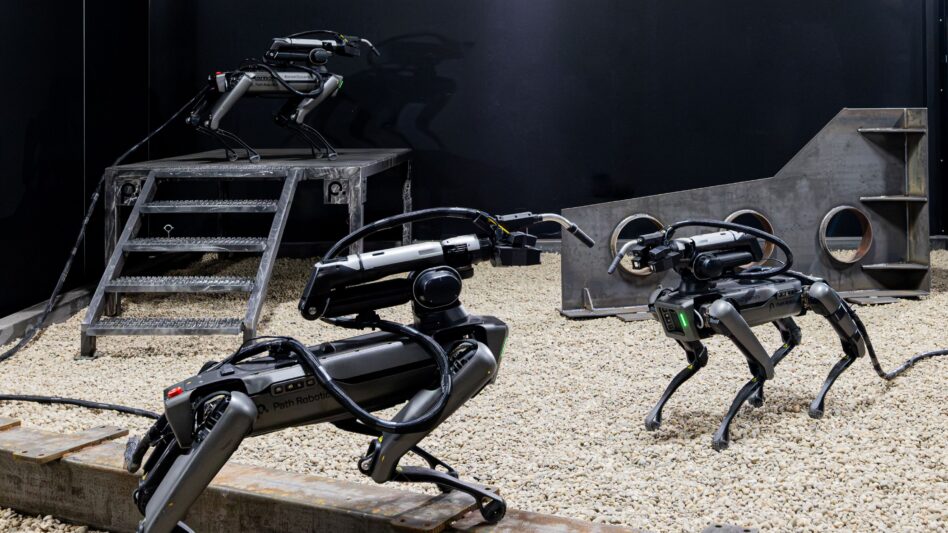
- The robots that Path’s physical AI models power mostly include fixed robotic cells, but they unveiled a robo-dog welder with Boston Dynamics called Rove that can, well, rove around the factory floor to bring “intelligent welding to the part rather than the part to the workpiece.” Path is now working to fill 50 preorders for Rove, including from Saronic.
The end result of that robo-AI fusion, according to the company, is a first-pass yield—the rate of welds that meet quality standards on the first attempt—of over 97 percent, compared to 70-85 percent for human welders.
That’s made it a hit, to say the least, especially with some big-name customers in the defense world. Path says its revenue has surged 17-fold over the past 18 months, and its partners now include Lockheed, HII, and Saronic.
- Path’s biggest contract to date is with shipbuilding giant HII, which signed a $600M performance-based deal with the startup under the High-Yield Production Robotics (HYPR) program to “rapidly accelerate advanced, adaptive automation solutions in the fabrication process of both crewed and uncrewed naval platforms.” Graymatter Robotics is part of that team too.
- The company also works with Lockheed (which has backed Path through its venture arm) and Saronic, which was one of the first adopters of Path’s Rove robo-dog and is now integrating it into its shipbuilding operations in Franklin, LA.
Scale up: With a fresh $300M in its pocket, Path is looking to expand its “physical AI capabilities across new robotic form factors and manufacturing tasks” beyond welding, including by boosting internal investment in “compute and model training.”
“We started with welding because it is one of the hardest jobs on the factory floor to automate, and we’ve proven that our technology can succeed in real production environments,” CEO Andy Lonsberry said in a statement. “This capital allows us to scale our welding business alongside our customers while investing further in the data, compute, and model development needed to take on every task before and after welding.”
“Our goal isn’t to automate one step, but to automate the entire factory,” he added.