It’s been a big year for both the drone and factory-of-the-future world so far, so it’s only right that the two come together.
In an exclusive announcement to Tectonic this morning, drone-maker Aevex ($AVEX) and additive manufacturing giant Divergent revealed that they’re partnering to develop a “next-generation autonomous platform.”
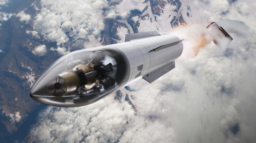
Under the deal, the pair will roll out an unmanned system in the “Group 2 to Group 3 UAV space,” but the partnership isn’t “necessarily about a specific platform,” Aevex CTO Manan Patel told Tectonic. “It’s [focused] on the development and production approach that we’re building together…and we believe this partnership is going to accelerate the path from that concept to production.”
- The goal is to design the drone (or, ultimately, drones) to be adaptable and mass-producible around Divergent’s 3D printing technology so that when requirements (range, payload, etc.) shift, production can shift with them—fast and at volume.
Drone dawgs: Before we get into the fun stuff, a bit of background on Aevex. Founded in 2007, the company has carved out a nice little niche for itself in the drone and “attritable autonomy” world. And by nice little niche, we mean over $200M in revenue last quarter, and billions of dollars in orders in the pipeline.
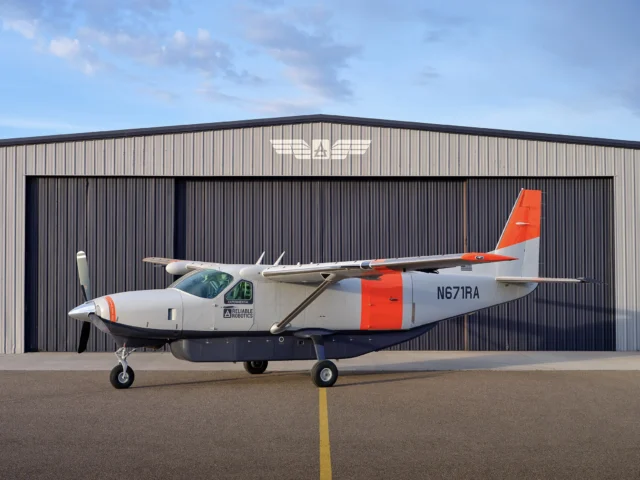
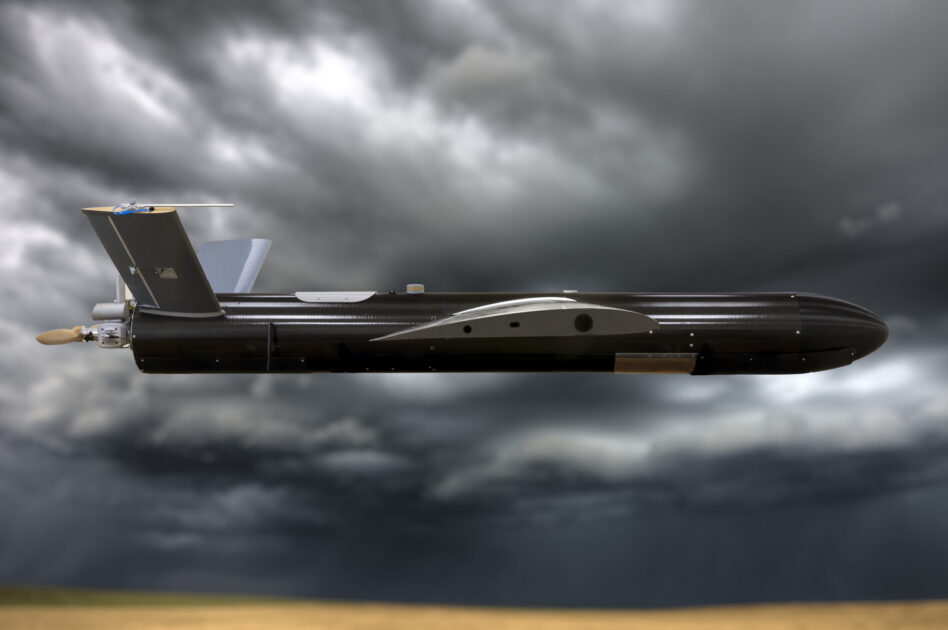
- Popular offerings include the Disruptor, a long-range Group 3 strike drone; Atlas, a precision strike system chosen by the US Army for the Launched Effects–Short Range (LE-SR) program; and Raker, an ISR drone with 16 hours of endurance and a range of 600+ miles. All that’s underpinned by Aevex’s CompassX autonomous sensor-fusion and navigation system.
- Several of Aevex’s precision strike drones fall under the “Phoenix Ghost” family of systems, developed by the Air Force and secretly deployed en masse to Ukraine starting in 2022.
- In its S-1 filing in April, Aevex said it has successfully executed on “critical strategic programs of record, with over 10,200 systems delivered and committed through the end of 2026 to operational environments.”
- They’ve bumped that up a bit in the past few months, inking an $88M Pentagon contract for “long-range precision strike systems” in July (we’re guessing this was for Disruptor), a $41M contract for “one-way attack systems,” and, last but not least, they snapped up unmanned-surface-vessel company BlackSea for $650M.
So, bottom line, Aevex has a lot of drones to build, and they’re betting that adding some fancy shmancy additive manufacturing to the process will help them deliver more of them faster, and make them easier to update as requirements shift.
That’s where Divergent comes in.
DAP me up: The advanced-manufacturing hotshot’s secret sauce is its Divergent Adaptive Production System (DAPS), a digital-manufacturing platform that combines AI-enabled engineering and design, 3D printing, and automated assembly.
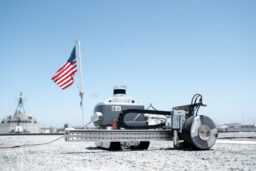
- Back in June, Divergent unveiled its giant (like, 26-foot tall and 20-foot wide) Monolith One printer, which uses high-powered lasers to selectively melt layers of metal powder, fusing the layers to build solid 3D structures. Their new factory will have 64 of these printers.
- Divergent works with pretty much every prime, and the airframes they’re printing using Monolith One include Tomahawk missiles, CoAspire’s RAACM low-cost cruise missile, and the “full Family of Affordable Mass Missiles (FAMM) and Low-Cost Containerized Missiles (LCCM) list of programs across the industry,” CEO Lukas Czinger told Tectonic.
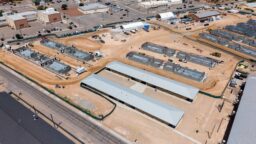
- With 64 printers in their nearly half-million-square-foot factory, he says each year they’ll be able to produce 275,000 parts, over 30,000 missile airframes in the 500-lb class, and over 60,000 warhead casings in the 100-lb class.
Printer go brrr: With most of its customers, Divergent is working with a standardized design and retroactively adding 3D printing into the process. With Aevex, the UAS and loitering munitions they design and produce will be built around Divergent’s manufacturing process (and Monolith One) from the get-go.
“Aevex will own the requirements of the system, certainly the integration of it, and they’ve got great, proven technology across the avionics, electronics, et cetera,” Czinger said. “We’ll create this tip-to-tail airframe that is best suited for that [DAPS] process, for adaptability, for low cost, for volume production from Day One. That’s a big piece of it: designing something that is actually meant to be scaled, but also compressing that overall process.”
“Building ten autonomous platforms is an engineering problem, but building 10,000 is an industrial problem,” Patel added. “Working with organizations like Divergent, we think that the folks that are going to succeed are going to be the ones that can continuously iterate, especially as operator requirements change, and we think we’re well positioned for that.”