We don’t have to tell you the interceptor shortage is very real and very dire, but much of this discussion focuses on Group 3 (i.e., Shahed-type) UAS threats. Russia and Iran certainly have used smaller, cheaper drones en masse, but a lot of the real damage—in Iran’s case—inflicted on US bases in the Middle East has been carried out with cruise and ballistic missiles.
Right now, taking out those fast-moving, maneuvering weapons is firmly the jurisdiction of super-pricey, super-backlogged exquisite Patriots and THAAD interceptors in critically short supply, but the Missile Defense Agency (MDA) is tapping X-Bow to develop and field a cheaper, more mass-producible alternative.
In an exclusive announcement in Tectonic this morning, the New Mexico-based solid rocket motor (and, increasingly, straight-up rocket) startup shared that it’s secured an $11M Phase II follow-on contract to develop and flight-test the X-Bow Low-Cost Interceptor (LCI) as part of the MDA’s Rapid Response Small Launcher Technology (RRSLT) program.
- The RRSLT program falls under the MDA’s Low-Cost Interceptor initiative.
- Under the deal, X-Bow will power the LCI with its own SRM, which, for one, is their whole thing, and, for two, solves one of the primary component supply chain chokepoints in interceptor production. All about that vertical integration, baby.
Boom on a budget: The MDA’s LCI and RRSLT (better acronyms, pls) program, according to the agency’s solicitation, seeks “enabling or revolutionary technologies” that “decrease the costs of kinetically intercepting ballistic, hypersonic, and cruise missile threats” to a sub-$750,000 price point.
- Sounds pricey for something with “low-cost” in the name, but that’s a heck of a lot cheaper than the interceptors (Patriots run about $4M a pop) that currently take out that class of aerial threat.
“Life cycle costs per magazine depth is key to this whole equation,” MDA director Air Force Lt. Gen. Heath Collins said about the LCI program at the recent Space and Missile Defense Symposium. “We’re taking a look at all the expensive parts of an interceptor to look for opportunities to drive down every bit of cost in there as we move forward.”
Motor madness: A focal point of X-Bow’s MDA deal is the SRM powering its interceptor—both one of the “expensive parts” and an obstacle to building that magazine depth. Per the Pentagon’s announcement, X-Bow’s “contract will aim to address the critical need to expand the SRM industrial base, which is currently reliant on a duopoly of two primary manufacturers.” (Those two would be L3Harris’ Aerojet Rocketdyne and Northrop Grumman.)
- At the same time, the Pentagon and L3Harris signed a seven-year framework agreement last month to boost SRM production for Patriot and THAAD interceptors (in support of deals inked with Lockheed to quadruple production of ’em), so demand for the exquisite stuff isn’t going anywhere anytime soon.
Hard launch: Luckily, making SRMs of all sizes is X-Bow’s bread and butter, and they’ve developed some fancy manufacturing tech to build ‘em at speed and scale. The startup provides, basically, an end-to-end energetics service, using 3D printing, a patented propellant, and additive manufacturing to vertically integrate SRM production.
- X-Bow’s SRM’s range from hypersonic and space-launch-size to smaller motors and rocket-assisted take-off (RATO) kits for Group 3 UAVs, including Aevex’s Disruptor drone, which it’s produced thousands of RATO kits for.
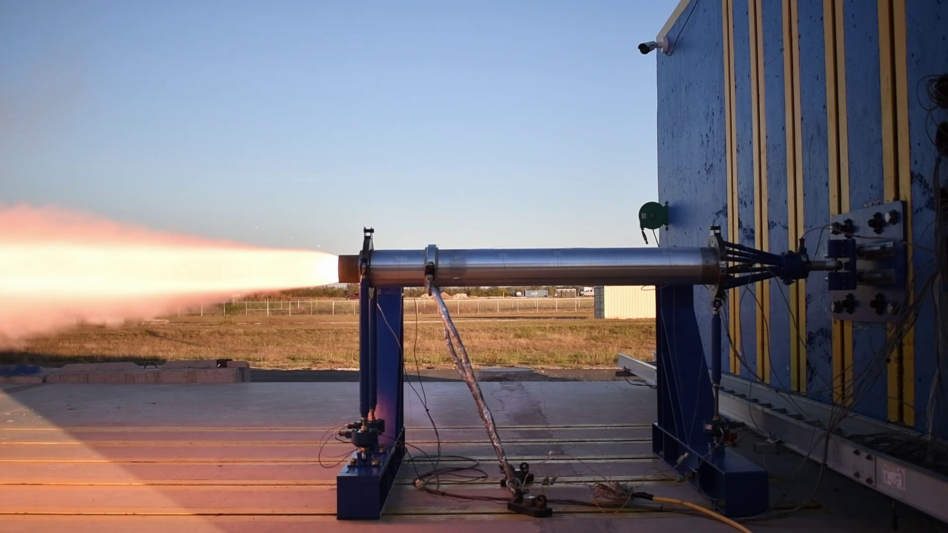
- In February, they successfully tested their 34.5-inch rocket motor, which X-Bow CEO Jason Hundley told Tectonic he thinks was “the largest [SRM] tested by a company not named Northrop Grumman and/or Aerojet Rocketdyne.”
- Lockheed (which builds those Patriots and THAADs) also tapped the startup as a “new independent supplier of SRMs and other services for their existing and future programs” after leading X-Bow’s $105M Series B funding round last year.
Flight to fight: “Our new manufacturing technology lets us bring affordable interceptors and rocket motors to the warfighter faster,” X-Bow CEO Jason Hundley said. “This award is a chance to prove it.”
- Hundley couldn’t share a lot of the deets on X-Bow’s LCI, but said that it’s compatible with “established US military defense architectures,” “optimized specifically for cost-effective interceptor missions,” and designed for flexibility “across multiple operational environments.”
- The program’s current phase focuses on further developing the interceptor’s motor, validating performance and cost-effectiveness, and proving it out in a test flight, he added.
Covering all the bases: Now, if X-Bow stepping into the interceptor game rings a bell, you’d be right—but this is different. The startup recently unveiled its Buckler interceptor, designed to down Shahed-type Group 3 drone threats at “supersonic” speed for under $100,000.
- In keeping with its shift towards full-stack solutions, X-Bow is building the Buckler’s airframe, solid-rocket motor, and propellant in-house.
- It can also take out rotary aircraft and provide point-defense against light cruise missiles, the company told Tectonic, and it’s already been flown in flight tests.
The LCI is a different beast, designed to “address a different tier of aerial threats with different range, speed, and engagement requirements” than the Buckler, per Hundley, which makes it “a complementary capability rather than a competing one.”
The Pentagon’s need for cheap and plentiful air defense systems that span the full range of threats—from Shaheds and quadcopters to ballistic and hypersonic missiles—isn’t going away anytime soon, so if what X-Bow’s putting on the table performs the way they want, things could get pretty busy in the Land of Enchantment.