We spend a whole lot of time around here talking about super-high-tech hardware (the go boom and zoom of it all), but we don’t spend a whole lot of time talking about how companies design that kit. That changes today.
This morning, LA-based generative design startup VXB announced (exclusively to Tectonic) an upgrade to its platform that it says is the “biggest update to its powerful generative design platform since launch.” They’re calling it Prospero.
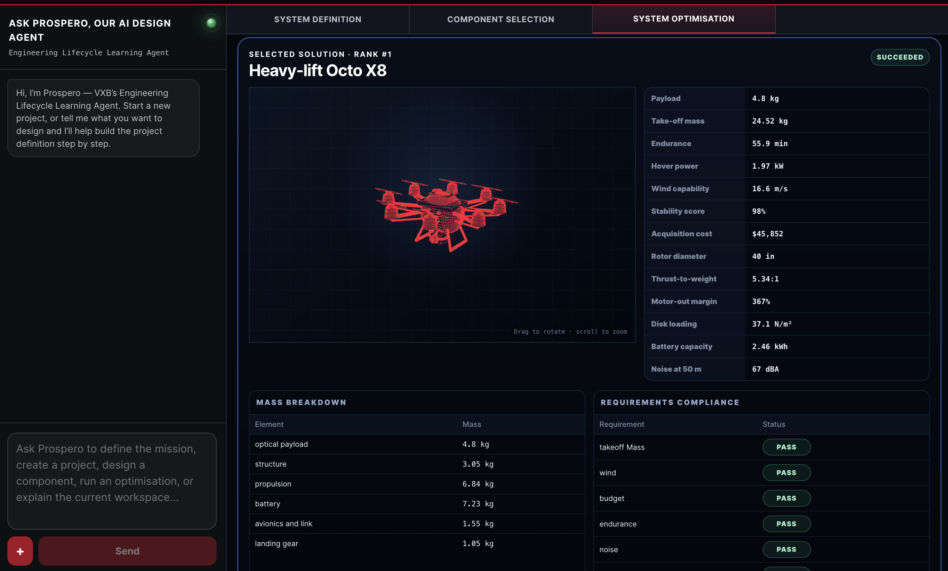
- Basically, users (generally engineers) can now use the platform to design everything from a single component all the way up to a “complete platform within one integrated workspace,” optimizing for everything from cost, to supply chain, to capabilities.
- The idea is that users can plug in a set of requirements, for example, then the tool designs the part or system (or upgrades the design of an existing part or system) and finds components to build it.
- Users can now also use natural language (rather than engineering speak) to design stuff. So, basically, you can be like, “I need you to redesign this drone so it only uses parts produced in the United States and allied nations, absolutely zero China,” and it can turn that into a real, usable design.
“Up until now, [the platform has] been a low-level engineering tool, essentially,” CEO and founder Alex Ryan told Tectonic. “It’s very sophisticated. It uses AI, but it’s been plugging into engineering workflows…Now, we have this output where it explains in a readable format why it’s chosen those designs, and then an engineer makes the final assessment on what will be the most useful.”
The rollout comes on the heels of a $4M seed (closed earlier this summer) led by Dauntless Ventures, with participation from Fulcrum Venture Group, Investible, and “strategic angels.”
“One of the things that pushed that raise across was all of the recent supply chain challenges that are being faced, like the blockage in the Strait of Hormuz,” Ryan said. “Now, [VXB] isn’t just this really cool technology that could help development. No, this is a critical technology that we really need ASAP.”
Aging backwards: Now, in case you haven’t noticed, there is a very prevalent trend of primarily software companies (ahem, Anduril and Helsing) pushing full-tilt into hardware. VXB has done pretty much the opposite.
- Ryan started out doing a PhD in propulsion design. While doing that, he came face-to-face with the, erm, grim reality of student funding—he only had about $500 available to build a propulsion system. In case you weren’t aware, they usually cost a whole heck of a lot more than that.
- So, he decided to use machine learning to try and solve the problem. He created an algorithm that would scan sites like eBay for parts that were under his budget, and optimize design for cost, performance, and speed of production.
- That ended up being the focus of his whole degree—basically, could he use machine learning to build a propulsion system for sub-$500?
Per Ryan, “It went very well.”
“The first design took two days to create, and then because I had all the listings for the parts and the materials and the ways to make it…I put it all together, and it was firing away,” he added. “It actually exceeded the predictions, which was really cool.”
“The propulsion systems that we started with…they take years to develop,” he added. “We were pumping out designs in two days to be manufactured in weeks. That’s a 50X speed-up in design and production.”
Spinning out: After graduating, he decided to spin this out into a full-blown company in 2022—basically, algorithmically defined propulsion systems designed and built to specific needs (or parts available). But as they started talking to customers, Ryan realized the design software itself was the draw. So, they pivoted.
“We decided to become a software company,” Ryan said. “It was night and day in terms of interest. We immediately started landing contracts, and our pipeline almost 10xed in the first few months. One of the first companies we spoke to was a prime.”
They ended up landing that prime contract (a $200K one-seat trial set to 10X to $2M for 10 seats), plus another customer with a $4M contract.
- Ryan said they’ve got three major customers so far, mostly “large defense contractors.”
- They’ve also got lots in the pipeline but were “at capacity,” he said. With the raise, they’re expanding their team from 10 (at the time of the seed) to 20, which means they can take on more work.
- And they’re not just doing propulsion systems—the platform can optimize designs for things like comms systems, or even commercial applications, too.
- Plus, it’s really helpful if, say, you’re trying to redesign something to include no Chinese parts. That’s applicable to, like, everything.
Scale up: In working with those customers, Ryan and his team realized that big ol’ defense companies weren’t just interested in using the software for components—they wanted to use it to optimize design at a system level, too. Hence, Prospero.
“We started at that component level, and we moved up to the system level,” he said. “There are definitely companies looking at that system-level design, but we started at essentially the raw, base-level components. With that, you can more efficiently adjust the materials and manufacturers are using up to a system level.”
By adding in natural language input and output, they’ve lowered the barrier to entry—you don’t need to be an expert engineer to improve a system’s design. That opens the door to things like production and repair optimization on the frontline.
Branching out: In the next year, the plan is to continue to scale up the team so they can bring on more customers. The more customers they have, the more systems and parts they have in their database, and the better the platform becomes.
“If you add as many different types of components as possible, you get this really interesting cross-understanding in the models where you can go build entirely new types of technologies with the platform,” Ryan said. “For example, you can build antenna systems that take on learning from the way that you’ve designed power systems and propulsion systems. You wouldn’t normally link these things directly, but then [with the model] you can see there’s sort of a non-intuitive, amazing increase in cost or performance.”