Get in, loser, we’re going nuclear. Well, at least the Army is.
Yesterday, the US Army announced it’s awarding five nuclear companies a collective $2.2B to deploy microreactors on five military installations under its Project Janus initiative.
The program was launched last year and aims to get at least one microreactor up and running by 2028 to give the Army a reliable, off-grid power source to keep bases operating during disruptions like, say, war.
Those companies and installations are:
- Antares, at Fort Bragg, NC;
- Radiant, at Fort Benning, GA;
- General Atomics Electromagnetic Systems, at Fort Hood, TX;
- BWXT, at Fort Campbell, KY;
- Westinghouse, at Fort Drum, NY.
“Awarding these contracts accelerates our ability to deliver safe, reliable baseload power directly to our installations,” Army Secretary (for now) Dan Driscoll said. “We are building the energy resilience necessary to project combat power globally, without relying on potentially vulnerable external grids.”
The contracts—a total of $2.2B between the five companies selected—are structured using a “milestone-based payment model,” under which “vendors will receive government funding only after successfully hitting specific technical goals,” the Army said.
The thinking behind that milestone structure is, as principal deputy assistant secretary of the Army for Installations, Energy and Environment, Dr. Jeff Waksman, told reporters, including Tectonic, this week, that “when you do complex engineering, there’s always a risk on schedules. This is part of why we have five companies, and this is why the process to select these companies was so rigorous.”
“We have really wire-brushed these companies, and we’re judging not just what they say their technology is, but their manufacturing capabilities, their supply chains, the teams that they’ve assembled,” he added.
Team effort: The Army’s also banking on a whole lot of private sector investment to get the reactors built and deployed. Waksman said the Army is “expecting that the majority of the money coming into these reactor programs will be private capital, not government.”
- With the billions in combined government and private capital, the Army ultimately expects “more than 20 total nuclear microreactors” to be delivered across Pentagon installations.
- However, “If a company is not performing, if they are just disappointing, not delivering what we’re expecting, we can pull future milestones,” Waksman said. How’s that for some motivation?
Youthful energy: Notably, two of the companies tapped for Janus—Radiant and Antares—come from the white-hot, cash-flush nuclear startup world.
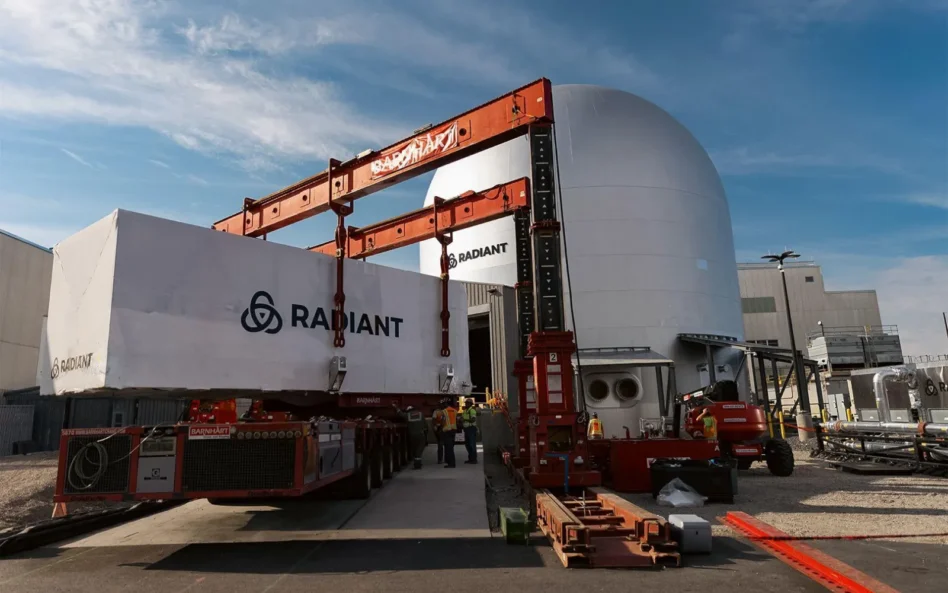
Antares didn’t disclose the value of its award through Janus, but Radiant was awarded up to $750M to develop and deploy 15 of its Kaleidos microreactors—one of the “largest contracts ever issued by DIU across its portfolio, and the largest award within the Janus Program,” according to the company.
- The two frenemies also passed through the Department of Energy’s Reactor Pilot Program this summer and have been selected to deploy reactors under the Air Force’s Janus equivalent, the Advanced Nuclear Power for Installations (ANPI) initiative.
- Under the ANPI program, Radiant is sending a microreactor to Buckley Space Force Base, and Antares to Joint Base San Antonio. Westinghouse was also tapped for ANPI.
Winner’s circle: Needless to say, Antares and Radiant are both pretty fired up about the Janus win, despite having (secretly) worked on it with the Army since the program was launched last year.
“We’ve been working with the Army for well over a year at this point. In fact, with the Mark-0 reactor that we tested, we had the Army regulator integrated into that process with us, so this has really been a long time coming,” Antares CEO Jordan Bramble told Tectonic. “I think one of the reasons the Army is so excited to work with us is because they’ve been seeing the technical rigor in our engineering culture for the better part of a year or more at this point.”
- Antares’ Mark-0 reactor was the first of the ten companies in the DOE’s Reactor Pilot Program cohort to reach criticality—when a nuclear fission chain reaction becomes self-sustaining—during a demonstration at the Idaho National Laboratory in June.
- They raised a very chill $470M Series C a month later.
- Bramble added that, counting Janus, Antares has “nearly two dozen reactors to build, and our work in space nuclear is starting to grow as well, so we’re nearly at a billion dollars in federal contracts to go build reactors that are enabling next-generation mission capabilities.”
- Last week, the company was also awarded a share of a $562.5M US Space Force Strategic Funding Increase (STRATFI) split between 11 companies developing tech “required to maintain space superiority.” Space nukes, anyone?
For Radiant, “The US Army is a very savvy customer. They’re very astute, and they have deep, deep expertise,” the company’s Chief Nuclear Officer Rita Baranwal told Tectonic. “What [the $750M award] says is that the Army has confidence in the technology itself and in Radiant, the partners that we have, and [our] ability to deliver not one, not two, but 15 reactors to the Army to provide the power we need at bases in the United States, and then, as you start to look into the future, around the world as well.”
“The military is the largest consumer of energy in the world, and so having energy independence, having a secure form of power that they can deploy where they need it, is incredibly important to them,” she added.
Nuking it out: Despite the “extraordinarily rigorous competition to determine which companies really have the best possibility to build commercial nuclear microreactors,” the Army doesn’t “expect all five of these companies are going to turn on a reactor in 2028,” according to Waksman. “In fact, they definitely will not, but we do believe we have a very practical pathway to delivering at least one of these reactors on/by September 30, 2028.”
The race—and pressure from the Army and investors alike—is on. Let’s hope that the “move fast and break things” startup ethos doesn’t extend to the nuclear world, but things are looking pretty good so far.