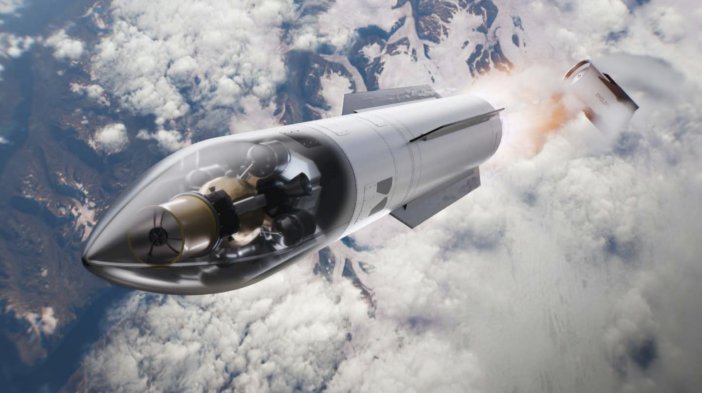
Turns out 2026 is a great year to be a low-cost interceptor company.
This morning, launch hotshot-turned-missile-defense-darling Long Wall (née ABL Space Systems) announced that it’s been awarded a $75M contract from the US Missile Defense Agency to “complete flight testing of [its] Cyclops low-cost interceptor.”
- The company kicked off testing for Cyclops back in 2024, and unveiled the interceptor in December 2025.
“Demand for interceptors has surged, while low production capacity and high unit costs remain major challenges to replenish expanded magazine depth,” Long Wall Co-Founder and CEO Dan Piemont said in a statement. “We bring a clean sheet design and a new approach to the table.”
Long Wall added that over the course of the award, they’ll also invest an additional $75M “at private expense” to scale up design and development of the interceptor.
Speedy quick: Now, while ABL-slash-Long Wall might be old hat for the Payload readers out there, we first covered them when they rolled out Cyclops back in December 2025.
- The company was actually first founded as ABL Space Systems back in 2017 to make small-satellite launch vehicles and other launch infrastructure, but struggled to get its stuff into orbit.
- They rebranded to Long Wall in February 2025 and pivoted—hard—to missile defense and hypersonic tech.
Eye on the prize: Cyclops is the flagship product to come out of that defense tech pivot—it’s a low-cost interceptor specifically built for the interceptor-scarce, we-want-a-Golden-Dome moment we’re all living in.
- In case you’re one of those blessed souls who, for some reason, doesn’t read the news, the US is facing a severe shortage of exquisite interceptors (like THAADs, PAC-3s, and SM-3s). According to CSIS, as of this summer, US Patriot inventories had fallen below 1,000, while THAAD stocks stood at roughly 250. SM-3s—the interceptor Cyclops is designed to replace—now stand at around half of their prewar levels (about 410 missiles).
- There are a bunch of reasons why these things are in such short supply—supply chain bottlenecks, prime monopolies, and a gazillion wars around the world—but it probably doesn’t help that the US fired off about 55 percent of its prewar Patriot interceptor stockpile and roughly half its THAAD and SM-3 inventories during the initial 39-day campaign of Operation Epic Fury.
- Plus, it doesn’t help that even if we did have them, these old-school, ultra-exquisite interceptors are super-duper expensive (up to about $30M a pop). When Tectonic spoke to Piemont around the launch of Cyclops, he said their platform was designed to be a “fraction of the cost.”
Big ups: While lower-cost, Cyclops isn’t necessarily one of those cheap-and-cheerful new-age interceptors—Piemont described it to us last year as “at the upper end of interceptors in the US arsenal.”
“It deploys an exoatmospheric kill vehicle at high velocity and has a range that’s relevant for theater and continental defense, not just point defense,” he added.
- It can also be integrated onto existing launchers for things like the SM-3. The company also has its own containerized launchers, but work with what ya got, ya know?
- Like the fanciest missiles out there, it’s also designed “to meet a range of missions, from counter-ICBM homeland defense to upgrading the IAMD systems of allies,” Piemont added. “Everything from MRBMs to ICBMs and hypersonic glide vehicles are in its target set.”
Build, baby, build: Long Wall says it already has a “mature, highly verticalized development, test, and production infrastructure [for Cyclops] spanning over 180,000 sq ft and 100 acres across three major facilities.”
- Under this shiny new contract, the company will invest alongside MDA to get these things rolling out at scale.
“We will continue investing alongside the MDA to ensure the US maintains a qualitative and quantitative edge over those who threaten us,” Piemont said.