Y’all really don’t take vacation around here, do you?
This morning, multi-domain orchestration wunderkind NODA AI announced that it’s won a $100M Pentagon contract to “scale autonomous mission command and software-defined effects across the Joint Force.”
The award comes just a few weeks after NODA announced that it had scored a $10M contract with the Pentagon to develop MAESTRO (Multi-Domain Autonomous Enhanced System for Tactical Reasoning and Orchestration) and advance NODA’s “integration with LUCAS (Low-Cost Uncrewed Combat Attack System).”
“Less than two years ago, we were a PowerPoint slide,” CEO and co-founder Philong Duong told Tectonic. “Now, we get to do the thing that was just an idea on a whiteboard in a very meaningful way, in the most important theater that is going on right now…We get to go pair up with current technologies that are [on] mature programs of record, and we’re going to go hopefully save some lives.”
Duong couldn’t tell us which theater, exactly, but we’re willing to venture a guess that it might rhyme with “Shmeeran.” But again, just a guess.
Knitting project: Now NODA should be no stranger to regular readers of Tectonic.
The company was founded back in 2024 by Duong and Thomas ‘Dave’ Corbett and has been laser-focused on solving a particularly annoying problem: Building the autonomy “brains” (otherwise known as the orchestration layer) that makes all the different autonomous assets y’all are building work well together on operations.
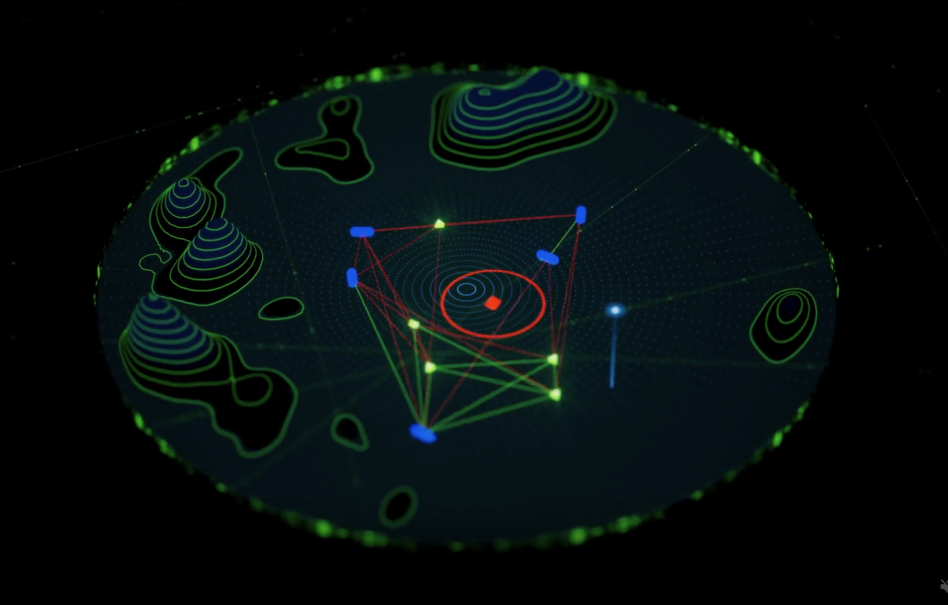
- The idea, per the company, is that everyone is building better “chess pieces” (drones, boats, robots, missiles), but no one was building the “chess player” (the orchestration layer that makes the whole thing go “checkmate”). That orchestration engine is called URZA.
- Instead of vertically integrating hardware and autonomy into one mega-system, NODA’s orchestration software is more of a horizontal play—it sits atop its partners’ platforms and command-and-control systems as a decision engine with pre-programmed playbooks.
- During onboarding, NODA programs an autonomous system’s specs into its synthetic environment. From there, it runs simulations to understand how the platform operates in different mission sets and threat environments—and, importantly, how it works alongside other platforms.
- Using those simulations, users can then draw up plays with that pre-loaded fleet and use it to respond to threats as they emerge.
In an ideal world, Duong told Tectonic earlier this summer, this enables “the projection of a commander’s intent down to the robots to execute across all different domains, from sub-sea all the way to space.”
That’s super useful in places where you’re using lots of new-fangled assets (like LUCAS) and responding to ever-evolving threats (like those from Iran and Russia) in places like the Strait of Hormuz.
Speed run: And it’s just not a pie-in-the-sky idea—they’ve got the backing of some pretty serious investors, plus, like, the military.
- They raised a $4M seed round last year, then another $25M in a Series A led by Bessemer at a $125M valuation back in February.
- The company was also selected alongside Anduril, Shield AI, Palantir, Lockheed Martin, Auterion, Helsing, and others to participate in the Pentagon’s CDAO Crucible 2 (Swarm Forge) for swarming capabilities.
- Last year, they also won an Air Force SBIR Phase II award to orchestrate autonomous platforms from different vendors.
- When they raised that Series A, they said they were working with both the US and UK MoD.
Big leagues: This new contract will be more of this orchestration work—just at a much, much bigger scale. The more resources the Pentagon pours into these assets, Duong said, the more need there is for something like what NODA is building—like, all the way across the Joint Force.
“Aside from the obvious financial upside here, it’s really a validation of a forward-looking thesis that we’ve been working on for the better part of a decade,” he said. “A lot of energy and resources [have been] going towards building robots and autonomy software for those robots, and rightfully so…but no one was really putting energy and focus towards building a reasoning engine…that understands capabilities and limitations, and pairs them up in the right way to create the desired end state.”
Confidence man: Duong sees this as a pretty massive win for the company (understatement of the century).
“We’re less than two years old,” he added. “There are large incumbents that proposed they build this, and we beat most of them in fair assessments by the government and were selected for these efforts. So yes, it’s a validation, it’s a vote of confidence, [but] really, for us, it’s an obligation to go do what we say we can do.”
And they ain’t stopping here. Duong said we’ll “see some more news coming out shortly” and that there is “another significant combatant command [that will adopt NODA] not only in the operations center but also on platform,” he said.
“Hint, hint, on boats, on naval vessels,” Duong added. Cheeky.
Mr. Worldwide: They’re also looking towards international partners in Europe, the Middle East, and the Pacific.
“You’re starting to see broad adoption across multiple combatant commands and theaters,” Duong said. “International partners are buying into this now. In a world where there’s a lot written, a lot of described capabilities, this is the most encouraging thing. [We’ve been] quietly building, taking the naysayers, and now we get to be validated. The people who have seen our technology are now validating it publicly.”